
The short version
After every storm season, Miami-Dade and Broward fill up with roofing companies, and some of them are not companies at all. Florida regulates roofing more tightly than almost any other state: the license is state-issued and public, the permit is filed under that license, every product must carry a Miami-Dade Notice of Acceptance, and since 2021 the law spells out what a roofer may and may not put in a contract or say about your insurance claim. That gives a homeowner five checks that take about half an hour and rule out most of the ways a roof job goes wrong.
This guide walks through them in order: the license, the insurance, the permit, the written scope, and the company's track record, then the red flags, the Florida rules on deposits and roof-claim inducements, and a ten-question checklist to take to any estimate, including ours.
Step 1: verify the license at DBPR
Roofing in Florida requires a state license from the Department of Business and Professional Regulation. A Certified Roofing Contractor's number starts with CCC and is good statewide; a Registered Roofing Contractor (RC) is limited to the local jurisdictions that approved it. A general contractor's license (CGC) is not a roofing license: under Florida Statute 489.113(3) a general contractor must subcontract roofing work to a licensed roofer unless the company itself holds a roofing certificate, and a general contractor may not even advertise as a roofer without one. A company that offers a general contractor's number for a reroof should be asked who holds the roofing license.
Look the number up on the DBPR license search (myfloridalicense.com). Check four things: the license is current, active; the licensee's name or the qualified business matches the name on the estimate; the address is in South Florida; and there is no open discipline. Florida law also requires the license number to appear on the contractor's contracts, proposals and advertising, so a truck, a card or a quote with no number on it is itself a warning. Ours are Florida Certified Roofing Contractor CCC1331964 and Certified General Contractor CGC1525978, both on our about page and on every estimate.
Step 2: the certificate of insurance, from the carrier
Two policies matter. General liability pays if the crew damages your house or a neighbor's; workers' compensation pays if someone is hurt on your roof, and without it an injured worker's claim can land on the homeowner. In Florida's construction industry, workers' comp is required for employers with one or more employees, and exemptions are limited to a few corporate officers or members who own part of the company, so a crew of six working under an "everyone is exempt" paperwork set is a crew you are insuring yourself.
Ask for a certificate of insurance issued to you by name as the certificate holder, sent by the agent or carrier rather than photocopied from a binder. Confirm the policy dates cover your job, and check the workers' comp coverage in the Florida Division of Workers' Compensation proof-of-coverage database, which is public. A roofer who is "fully insured" but cannot produce a certificate within a day usually is not.
Step 3: the permit is pulled under the contractor's license
A roof replacement in Miami-Dade or Broward needs a building permit from the department that serves your address, inside the Florida Building Code's High-Velocity Hurricane Zone (HVHZ), with a Miami-Dade Notice of Acceptance (NOA) for every component from the underlayment to the ridge. The permit must be filed under the contractor's license. Two things on this step are red flags on their own: a contractor who asks you to pull an owner-builder permit (which makes you the contractor of record and voids most of your protections), and anyone who says a reroof "doesn't need a permit." It does, and the permit record is what your insurer, a buyer's inspector and the county's 25% rule will all look at later.
Before you sign, ask for the NOA number of each product and look it up in the Miami-Dade Product Control search; the approval should be current, name the exact product on your quote and list the attachment method the crew will use. Our guide to Miami-Dade roof permits, NOAs and the HVHZ walks through each inspection a reroof passes and what permits typically cost.
Step 4: the written scope
A roofing contract in Florida is where most disputes start, so it is also where most of the protection is. A good scope reads like a parts list with a schedule attached. It should state:
- Tear-off to the deck, not a roof-over, with an allowance per sheet of plywood for rotten decking and the re-nailing the inspector checks.
- The underlayment type (self-adhered, hot-mopped, high-temperature under metal) and the secondary water barrier that earns the wind-mitigation credit.
- Every product by name with its NOA number: tile or shingle or panel, underlayment, adhesive or fasteners, edge metal, vents, flashing.
- Flashing and penetrations: chimneys, walls, pipe boots, skylights, and who handles the gutters and solar panels if there are any.
- The permit and inspections, pulled and scheduled by the contractor, and the closed permit and NOA package handed to you at the end.
- Two warranties: the manufacturer's on materials, registered in your name, and the contractor's own labor warranty, in writing with its term.
- A payment schedule tied to inspections: a deposit, a draw at dry-in or an in-progress inspection, and the balance only after the approved final.
- Start and completion dates, debris removal and the magnetic sweep of the yard for nails.
Florida adds some lines of its own. Residential contracts over $2,500 must carry the notice of the Florida Homeowners' Construction Recovery Fund (Statute 489.1425), with the Construction Industry Licensing Board's address and phone number. Every roof repair or replacement contract must include a bold 14-point insurance advisory on the signature page telling you to check with your carrier before signing if the work relates to a claim, and a notice that the contractor may not offer you anything in exchange for a claim (Statute 489.147). If those notices are missing, the contract was not written by someone who roofs in Florida for a living.
Step 5: proof the company exists and does the work it shows
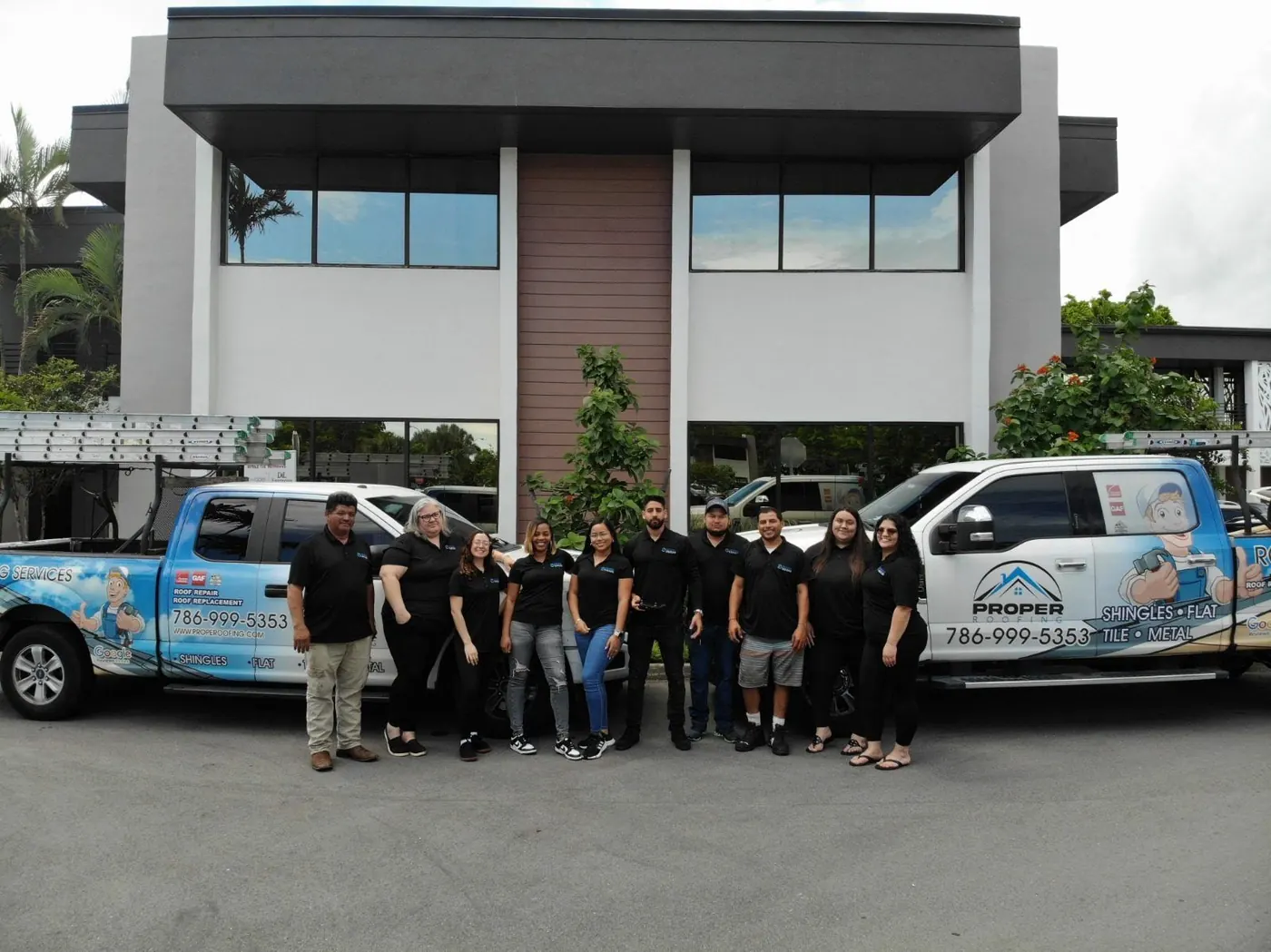
A website full of stock roofs says nothing. Look for photos of the company's own jobs with the city named, reviews that mention the service and the city rather than a first name and five stars, a street address you can drive to, and trucks and crews in the company's name rather than a different name on every visit. Ask how long the company has worked in Miami-Dade and Broward and whether the crew on your roof is theirs or a subcontractor's; both are legitimate, but you should know who is up there and whose insurance covers them. Our office is at 1011 Ives Dairy Road, Suite 210, in Miami, every job in the project portfolio was photographed by the crew that built it, and the North Miami roof replacement page shows what that looks like on one city's housing stock.
| Check | Where | Good answer | Walk away if |
|---|---|---|---|
| License | DBPR license search (myfloridalicense.com) | A current CCC (or RC for your city) in the company's name; number printed on the estimate | No number, a borrowed number, a CGC offered as a roofing license, or a name that does not match the contract |
| Insurance | Certificate from the agent or carrier; Florida workers' comp proof-of-coverage database | General liability and workers' comp, dates covering your job, you listed as certificate holder | A photocopy, an expired date, or "all our guys are exempt" |
| Permit and NOAs | Your city or county building department; Miami-Dade Product Control search | Permit under the contractor's license; current NOA for every product on the quote | "No permit needed," an owner-builder permit, or products with no NOA numbers |
| Contract | The written scope and contract itself | Products by name and NOA, underlayment type, deck allowance, two warranties, inspections, payments tied to them, the Florida notices | A one-page price with "new roof" on it, final payment before the final inspection, or no cancellation and insurance notices |
| Track record | Portfolio with cities, reviews, the office address, the trucks | Own jobs photographed and named by city; an office you can visit; years in South Florida | Out-of-area address, a different company name on the truck, or reviews that never name a job |
Red flags, and the Florida rules behind them
- The knock on the door after a storm. Storm chasers follow hurricanes from state to state, sell fast and leave before the first leak. Florida gives you protection here: a home-solicitation contract can be cancelled within three business days under Statute 501.025, and a roof contract signed within 180 days of a Governor's emergency declaration, for a property in the declared area, can be cancelled within 10 days of signing or before work starts, whichever comes first, under Statute 489.147(6). The contract must say so in 14-point bold type above your signature.
- "We'll cover your deductible" or a gift card for letting us inspect. Since 2021, Florida law prohibits a contractor from offering a rebate, gift, cash, coupon, deductible waiver or anything of value in exchange for a roof inspection or an insurance claim, and waiving a deductible is insurance fraud. Door hangers and flyers that push you to file a roof claim must carry the same warning. Any contractor offering it is telling you how they treat the rules.
- Pressure to sign over your claim. Assignment-of-benefits agreements are prohibited on residential property policies issued on or after January 1, 2023 (Statute 627.7152). A roofer who wants to deal with your insurer on your behalf as a condition of the job is working from an old playbook.
- A large deposit with no permit date. Florida does not cap deposits, but under Statute 489.126 a contractor who takes more than 10% of the price up front must apply for the permit within 30 days and start work within 90 days of the permit being issued. Ask for the permit application date in writing, and keep the final payment for the approved final inspection.
- A cash discount for skipping the permit, a price far below the rest, or a quote given from the street. Each one means a layer of the roof, or of your protection, is being left out.
The ten questions to take to every estimate
- What is your roofing license number, and whose name is on it?
- Can you send a certificate of insurance for general liability and workers' comp, with me as certificate holder?
- Who pulls the permit, and under which license?
- Which products will go on the roof, and what is the NOA number for each?
- Is this a tear-off to the deck? What is the plywood allowance per sheet?
- What underlayment, and does the scope include the secondary water barrier for the wind-mitigation form?
- What are the manufacturer's warranty and your labor warranty, in writing, and for how long?
- What is the payment schedule, and is the last payment tied to the approved final inspection?
- When does the work start and how long will it take, and what happens if a storm is forecast mid-job?
- Is the written repair-or-replace call free, and will you show me the photos behind it?
That last question matters because in Miami the answer is often "repair." A company that does both repairs and replacements has less reason to steer you; our repair-or-replace guide explains the 25% rule that decides many of those calls. Atlantic hurricane season runs June 1 through November 30; the calm months from December through April are the easiest time to get three written scopes, compare them line by line and have the roof permitted, inspected and closed before the next season, with $0-down PACE or loan financing if the budget needs it.