
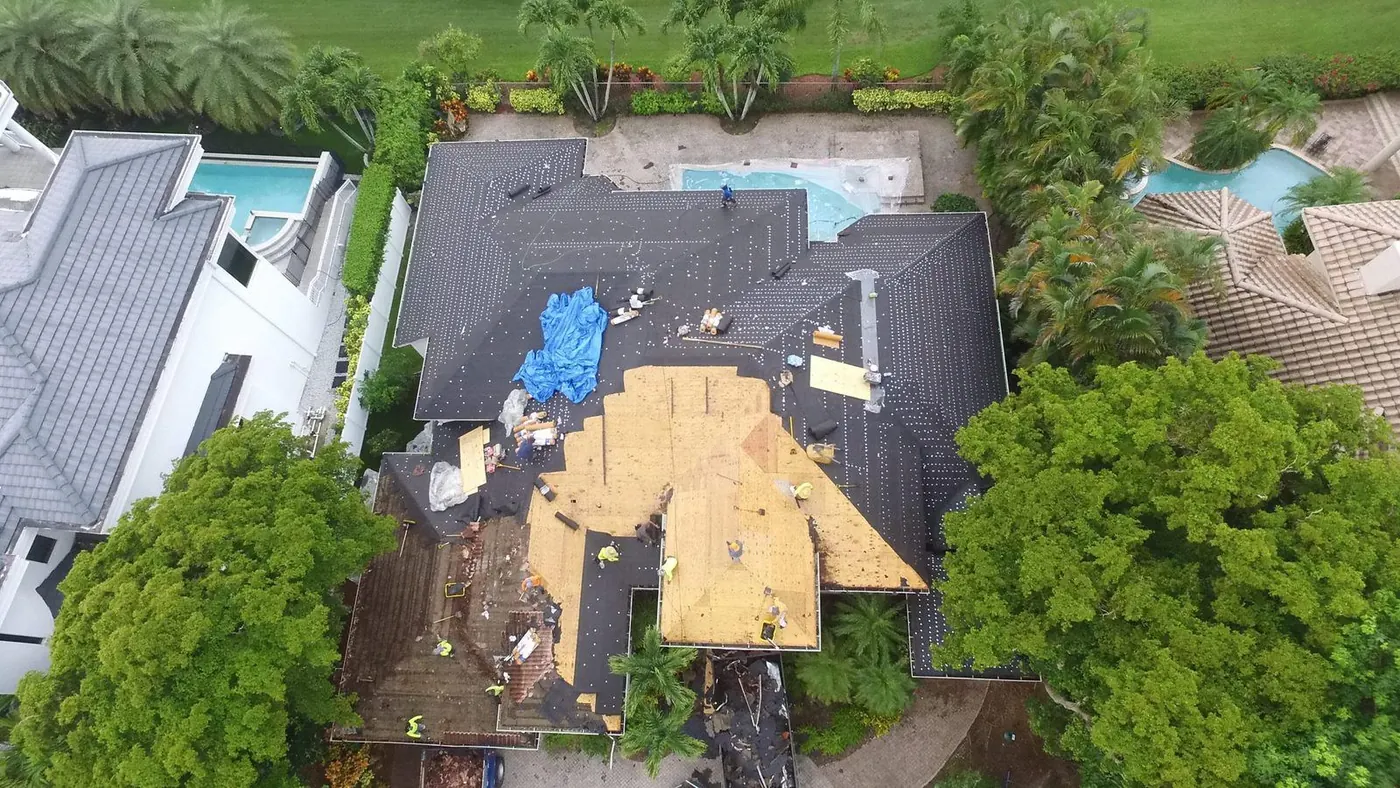
The short version
A ceiling stain in Miami raises the same two questions every time: can this be repaired, and will the repair hold? Most leaks can be fixed for a few hundred to a couple of thousand dollars when the roof underneath is still sound. The answer changes when the underlayment is at the end of its life, when the leaks keep moving, or when the repair is large enough to trip the Florida Building Code's 25% rule, which can turn a patch into a section replacement by law.
This guide covers where South Florida leaks start, the questions that decide repair versus replace, the 25% rule and its 2007-code exception, repair permits in the High-Velocity Hurricane Zone, what insurance pays for, and typical costs.
Where Miami roof leaks actually start
Water almost never comes in where it shows up. On a tile roof the tile sheds most of the rain, but the layer that keeps the house dry is the underlayment beneath it. Wind lifts or cracks a tile, rain gets under it, and the water runs along the underlayment until it finds a nail hole or a worn spot, sometimes ten feet from the stain. The most common sources on South Florida roofs:
- Slipped, cracked or missing tiles, and loose mortar at hips and ridges on older tile roofs.
- Flashing at chimneys, walls and skylights, and split rubber pipe boots the sun has cooked for 15 years.
- Valleys, which carry the most water, once the metal or underlayment under them wears through.
- Lifted or nail-popped shingles after a windstorm.
- Flat sections on additions, carports and porches: ponding, failed seams, blistered cap sheet.
- Underlayment at the end of its life, which shows up as several small leaks in different rooms rather than one.
That last one is the dividing line. A single failed component on a roof with years of life left is a repair. Brittle underlayment under 25-year-old tile is a replacement, and a repair on it buys a few dry months. Either way a leak is urgent here: wet plywood rots and grows mold faster in South Florida's heat than almost anywhere in the country.
Repair or replace: the questions that decide it
A good estimator settles this on the roof, not on the phone. These are the questions we work through, and the ones worth asking any roofer who gives a quick answer either way.
- How old is the roof, and when was the underlayment last replaced? Tile lasts 30 to 50 years in South Florida, but the underlayment under it typically lasts 20 to 30. A 12-year-old tile roof with one broken tile is a repair; a 28-year-old one on its original underlayment usually is not.
- How many places is it leaking? One source is a repair. Three rooms with stains is a system failing.
- Can the material be matched? Many tile profiles and colors from the 1980s and 1990s are discontinued. Salvage tile moved from a hidden slope, or a close match, is often workable; a roof that needs dozens of a tile that no longer exists is harder to repair well.
- What does the deck look like? Soft spots underfoot and dark, delaminated plywood seen from the attic mean the leak is older than the stain suggests.
- How big is the repair? This is where the Florida Building Code comes in.
Florida's 25% rule, in plain language
The Existing Building volume of the Florida Building Code (Section 706.1.1) says that no more than 25 percent of a roof section may be repaired, replaced or recovered in any 12-month period unless the whole roof section is replaced to current code. A "roof section" is a separately framed area of roof, so a tile main roof and a flat porch roof are separate sections. The practical effect: a small repair is a repair, but once the damaged area passes a quarter of that section, the code requires bringing the entire section up to today's standard, which on an older roof means a replacement. The code books are published by the Florida Building Commission at floridabuilding.org.
In 2022 the Legislature added an exception in Florida Statute 553.844(5): if the existing roof was built, repaired or replaced under the 2007 Florida Building Code or a later edition, only the part being repaired has to meet current code, whatever its size. The permit record is how you prove it. A roof permitted and finaled under the 2007 code or later can take a large storm repair as a repair; one that predates it, or was never permitted, still faces the 25% line. Keep the closed permit from any reroof, and check it before an adjuster or a contractor tells you the whole roof has to go.
| Repair | Replace one roof section | Full replacement | |
|---|---|---|---|
| When it fits | One or two identified sources on a roof with sound underlayment and matchable material | Damage or wear confined to one framed area (a flat addition, a porch) while the main roof is sound; or a repair that crosses the 25% line on a pre-2007 roof | Underlayment at end of life, leaks in several places, deck damage, or a roof carriers will no longer insure |
| Typical cost | A few hundred dollars for a simple tile, shingle or boot repair; more for flashing, valley and flat-roof work, typically into the low thousands | Priced by the section's area and system; usually a fraction of a whole roof | Priced by area, pitch, material and decking; quoted in person. $0-down PACE and loan financing available |
| Permit | Minor work may fall under your building department's repair exemption; larger repairs need a roofing permit with NOA products | Roofing permit for that section, inspected like a reroof | Roofing permit with the full HVHZ inspection sequence |
| Insurance paperwork | Photos and a written report; a repair does not change the wind-mitigation form | Permit and NOAs for the section | Permit, NOAs and photos for a new wind-mitigation inspection, which is where the premium credit comes from |
Repair permits in the High-Velocity Hurricane Zone
Miami-Dade and Broward are the Florida Building Code's High-Velocity Hurricane Zone, and that applies to repairs as well as new roofs. Replacement tile, underlayment, cap sheet, flashing metal and even the foam or mortar that sets a tile must carry a current Miami-Dade Notice of Acceptance (NOA) for HVHZ use, installed by the attachment method in that approval. You can check any product in the Miami-Dade Product Control search; our guide to Miami-Dade roof permits and NOAs explains how to read one.
Whether a repair needs a permit depends on its size and on the department that serves your address: Miami-Dade County for unincorporated areas, the city's building department in Miami Gardens, North Miami Beach or Aventura, and on the Broward side cities such as Hallandale Beach and Hollywood. Small repairs often fall under a department's minor-repair exemption; larger ones are permitted and inspected much like a reroof. A licensed roofer should say which applies and put it on the estimate. Unpermitted repair work also undercuts the 2007-code exception above, since there is no record of the work having met code.
What a roof repair typically costs in Miami
Repairs are priced by what is wrong, how hard it is to reach and what it takes to match. As a guide, not a quote: resetting a few tiles, replacing a pipe boot or sealing a small flashing is typically a few hundred dollars; rebuilding a valley, reflashing a chimney or wall, or repairing a section of flat roof runs higher, typically into the low thousands; and lifting tile to replace the underlayment beneath it is the most expensive repair and the one most likely to raise the replacement question instead. Pitch and height, tile matching, decking that has to be replaced (billed by the sheet) and timing all move the number; the weeks after a named storm are the most expensive and slowest time to get on a schedule.
A free inspection should come before any number. We photograph the source, show you the pictures and quote the repair in writing; if the honest answer is that the roof is done, the replacement quote comes with the same photos and a scope listing every product and its NOA.
Will insurance fix a leaking roof?
Sometimes. A standard Florida homeowner's policy covers sudden damage from a covered peril, such as wind tearing off tile during a storm, and the interior damage that follows. It does not cover wear and tear: brittle underlayment, cracked old mortar or a sun-worn boot is maintenance, and a claim for it will be denied or paid at a small fraction. Many policies pay older roofs at depreciated value, and Florida law now lets insurers offer a separate, higher roof deductible, so read the declarations page before assuming a storm claim pays for a new roof. Insurers must also offer premium credits for wind-resistant features documented on the wind-mitigation form (OIR-B1-1802); a repair does not change that form, while a replacement earns a new inspection. The form and consumer guidance are on the Florida Office of Insurance Regulation's wind mitigation resources page.
Two rules from Florida's 2022 insurance reforms matter here. First, the clock: under Florida Statute 627.70132, notice of a new property-insurance claim must reach the insurer within one year of the date of loss, and a supplemental claim within 18 months, so damage found in spring from last fall's storm is on a deadline. Second, roof age: insurers may no longer refuse to write or renew a policy solely because a roof is under 15 years old, and for a roof 15 or older the homeowner can supply an inspection showing at least five years of remaining life. A documented repair plus that inspection can keep an older roof insurable; when no inspector will certify five years, the renewal often turns on replacement.
Whatever you decide, document the roof the day you find the leak: dated photos from the ground and the attic, the storm date if there was one, and a written inspection report. We provide that report with every repair estimate and meet adjusters on site. Our insurance savings calculator shows how a replacement changes the wind-mitigation credits.
Hurricane season, emergency tarps and timing
Atlantic hurricane season runs June 1 through November 30. A leak found in May should be fixed before the season; one found in September with a system in the forecast gets a tarp first and the permanent repair when the weather clears. After a named storm, demand spikes across Miami-Dade and Broward and schedules stretch for weeks, which is when unlicensed crews and door-knockers appear. Verify any contractor's license at myfloridalicense.com, and never sign an open-ended contract on the doorstep.
Our emergency crews are on site within 3 hours to tarp a storm-damaged roof. A tarp is a temporary dry-in, not a repair; it buys time to document the damage, start the claim and get matching materials. Hallandale Beach, Aventura and North Miami Beach are minutes from our office on Ives Dairy Road; see how a repair call runs on the Broward side on our Hallandale Beach roof repair page.
How to get a straight answer
Ask for the three things a repair-or-replace call rests on: photos of the leak source, the age and condition of the underlayment, and the roofer's position on the 25% rule and the 2007-code exception for your roof. Then ask what the repair will cost, what it will be made of (with NOA numbers), whether it is permitted, and what the same roofer would charge to replace. A contractor who does both repairs and replacements has no reason to steer you to either, and that is the answer we aim to give on every roof repair visit. If it does come to a new roof, $0-down PACE and loan financing and the wind-mitigation credit soften it.