
The short version
A metal roof in Miami comes down to four decisions: the metal (aluminum or Galvalume steel), the panel (standing seam with concealed clips, or 5V-crimp with exposed screws), the finish, and the roofer who has to build it to the Florida Building Code's High-Velocity Hurricane Zone rules. Get the first one right by measuring how far your house is from salt water, and most of the rest follows.
This guide covers why South Florida homeowners are switching to metal, the aluminum-versus-Galvalume rule, the panel profiles, the cost drivers behind the per-square range on our metal roof page, what the HVHZ permit requires, the insurance credits, and the questions about noise, lightning and solar that come up at almost every estimate.
Why Miami homes are switching to metal
Most Miami-Dade and Broward homes were built between the 1950s and the 1980s under barrel tile or, on later streets, architectural shingle. When the underlayment under 25-year-old tile has failed, the choice is a new tile roof or something else, and metal is winning more of those decisions for four reasons.
- Weight. A standing-seam metal roof weighs roughly a pound to a pound and a half per square foot; concrete tile weighs several times that. Trusses that carried tile carry metal, and a house built for shingle can usually take metal without the engineering a switch to tile would need.
- Heat. A light-colored Kynar 500 finish reflects a large share of the sun's energy instead of soaking it into the attic, which matters on a one-story CBS house with little shade.
- Life. We rate metal at 40–60 years in South Florida, the longest of the four systems we install.
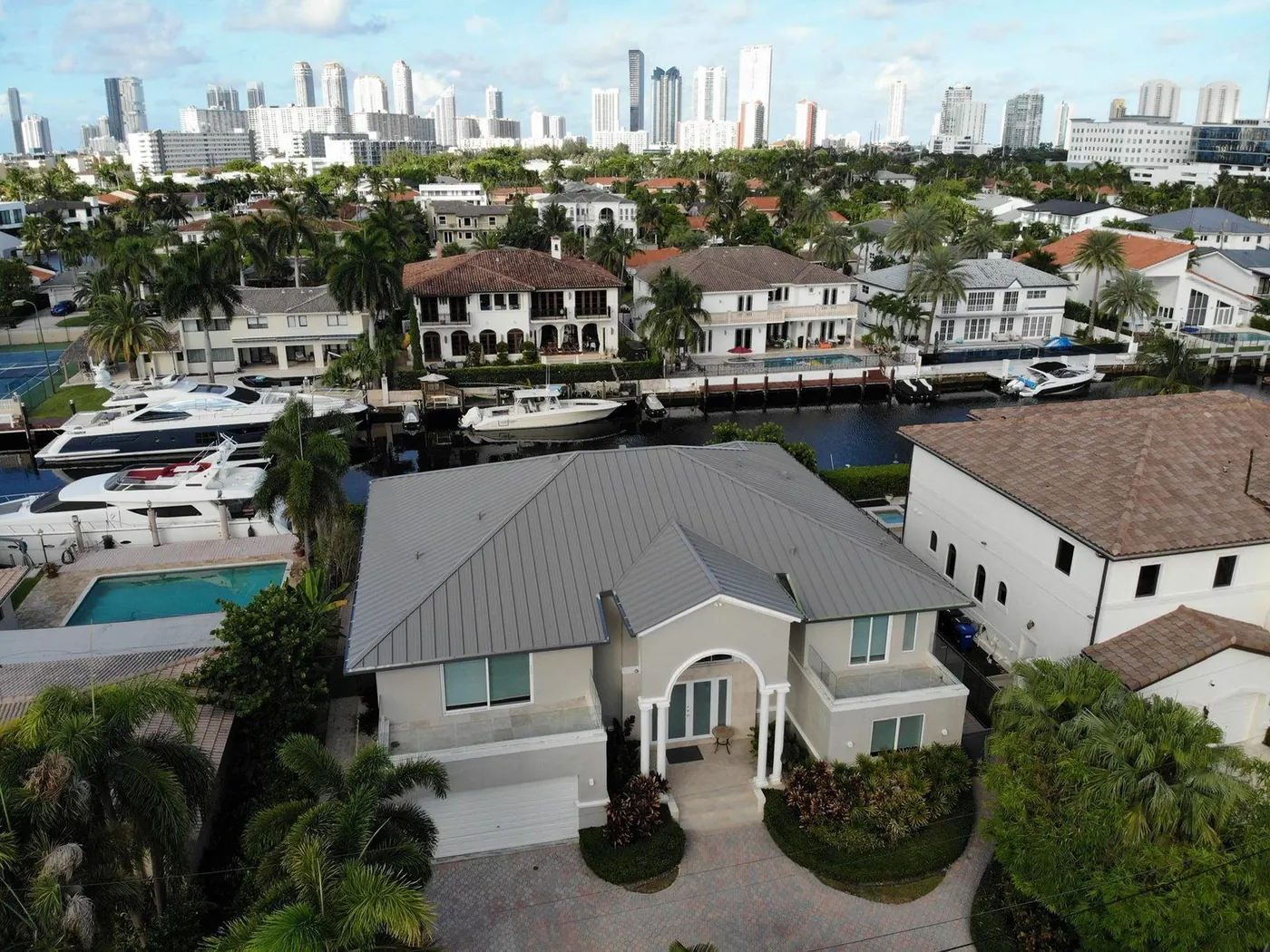
- Wind. Standing-seam panels held by concealed clips carry some of the highest uplift ratings of any residential roof, which is why they are a common sight on waterfront homes.
The trade-off is the upfront price: metal costs more than shingle and overlaps with tile, so it makes the most sense on a house you plan to keep, or where the next roof should be the last.
Aluminum or Galvalume: the salt-air rule
Both metals are painted standing-seam panels with the same Kynar 500 color chart, so from the street they look identical. The difference is what is under the paint and how it behaves in salt air.
Aluminum cannot rust. Salt spray that pits a steel panel at its cut edges and fastener heads does nothing to aluminum. We install .032-inch aluminum, a thickness that stays flat and resists dents at residential panel widths, with stainless or coated fasteners and concealed clips so no bare steel hardware is left in the weather. It costs more than steel and is lighter on the house.Galvalume is steel with an aluminum-zinc alloy coating under the paint. It is stiffer than aluminum, so panels stay flatter and cost less. We install 24-gauge Galvalume, heavier than the 26-gauge many roofers quote. Its limit is salt: many steel panel warranties are reduced or excluded within a set distance of salt water, and a scratched edge near the coast will eventually show it.Our rule is distance. Within about a mile of the ocean, Biscayne Bay or the Intracoastal, which takes in the beach cities, the canal streets of North Miami Beach and the finger islands of Hallandale Beach, we specify aluminum. Inland, in Miami Gardens, Hialeah or Pembroke Pines, Galvalume gives the same look and wind rating for less money. We quote both whenever a homeowner wants to compare; the aluminum-versus-steel explainer on our metal roof page shows the two side by side, and the North Miami Beach and Miami Gardens metal pages show each choice on a real street.
Standing seam, 5V-crimp or metal shingle: the panel decides the maintenance
The panel profile sets how the roof is fastened, how it handles wind-driven rain, and what it will ask of you in 20 years.
| Profile | How it is fastened | Looks | Wind and water | Maintenance |
|---|---|---|---|---|
| Standing seam (concealed fastener) | Panels formed to the full rafter length, held by clips hidden under the seam; the seam is folded once (single-lock) or twice (double-lock) per the product's NOA | Clean vertical lines; flat, striated, pencil-rib or bead-rib faces; 38 Kynar 500 colors | Highest uplift ratings; double-lock seams are tightest against wind-driven rain and work on lower slopes | No exposed screws to re-seal; the finish is the only wear item |
| 5V-crimp (exposed fastener) | Panels screwed through the face with gasketed screws into the deck, on the pattern in the NOA | The classic Florida farmhouse and bungalow look, same color chart | Approved for the HVHZ when installed per its NOA; relies on hundreds of gasketed fasteners | Gaskets age in the sun; expect to check and eventually replace fasteners over the life of the roof |
| Stamped metal shingle or tile | Interlocking panels fastened at hidden flanges | Mimics tile or slate at a fraction of the weight | Approved per its own NOA; ratings vary by product | Few exposed fasteners; matching a discontinued pattern later can be hard |
Which one we recommend
For a home near salt water, or any roof the owner wants to be done with, standing seam: the clips let the panels expand in the heat without stressing a screw, and nothing is exposed for the salt to work on. 5V-crimp is a legitimate HVHZ roof and costs less on a simple hip roof, but every screw is a future maintenance item, and most of the metal repairs we do are on exposed-fastener roofs. Panel faces (flat, striation, pencil rib, bead rib) are a question of looks and of controlling the slight waviness called oil canning on wide flat panels; all four, and the 38 colors, are on our materials and colors page.
What a metal roof costs in Miami
Our instant roof quote prices a metal roof at $950–$1,600 per square (100 square feet of roof) from a satellite measurement of your house, against $470–$750 for architectural shingle and $850–$1,400 for tile. The written price follows a free on-site inspection. Within that range, these are the lines that move the number, roughly in order:
- The metal. Aluminum costs more than Galvalume at the same panel width.
- The profile. Standing seam costs more than 5V-crimp because of the clips, seaming and panel forming; the gap is smaller on a simple hip roof than on a cut-up one.
- Gauge and finish tier. 24-gauge over 26, and the color: Kynar 500 charts run standard, premium and ultra-premium.
- Roof complexity and pitch. Every hip, valley, skylight and wall tie-in is hand-formed trim; a steep roof slows the crew.
- Tear-off and the deck. Old tile is heavier to remove than shingle; rotten plywood is replaced and billed per sheet, never as a lump.
- Underlayment. Metal gets hot, so the self-adhered sheet under it has to be a high-temperature product with its own NOA.
- Flat sections. A porch, carport or Florida-room roof usually gets new modified bitumen or TPO under the same permit.
Permit fees are set by each building department and usually figured on roof area; as a public example, the City of Miami Gardens' roofing fee sheet charges $0.17 per square foot for tile and metal with a $138.25 minimum, so a single-family metal roof permit typically runs from a few hundred dollars up, and it should be a line on the estimate. Over the life of the house the math changes: an architectural shingle roof lasts 20–30 years here, so a metal roof at 40–60 replaces two of them, with lower cooling bills in between.
The HVHZ permit: what the inspector checks on a metal roof
Miami-Dade and Broward are the Florida Building Code's High-Velocity Hurricane Zone, and a metal roof is permitted and inspected like any other reroof: the application goes to your city's building department (or the county for unincorporated addresses) with a Miami-Dade Notice of Acceptance for every component, and the work is inspected before each layer is covered. On a metal roof that means several NOAs, not one: the panel system (metal, gauge, seam type and the widest panel tested), the clips and fasteners with the spacing that earns the uplift rating (tighter at eaves, rakes and corners, where wind pressure is highest), the high-temperature underlayment, and the edge metal and trim tested with the panel.
The inspections are the deck re-nailing after tear-off, the dry-in (sealed underlayment, edge metal and tin-cap pattern), the panels and clips in progress, and the final. Seam type and clip spacing are set by the panel's NOA, which is why we do not promise a seam before we have your roof's approval in hand. You can check any NOA in the Miami-Dade Product Control search, the code itself is published by the Florida Building Commission at floridabuilding.org, and our guide to Miami-Dade roof permits and NOAs walks through the paperwork step by step.
Kynar 500 finishes and what the warranty covers
Kynar 500 is the trade name for the PVDF resin in the paint on a quality metal roof panel; it holds its color under South Florida sun where cheaper polyester paints chalk and fade. Panel manufacturers back it with a written finish warranty against chalking, fading and peeling that runs decades, and we register it in your name at the final inspection. Read the salt-water clause before you sign: on steel panels the finish and substrate warranties are often shortened or excluded near the coast, one more reason the waterfront answer is aluminum.
Insurance: a metal roof earns the same credits as tile
Florida law requires insurers to offer premium credits for wind-resistant construction, documented on the Uniform Mitigation Verification Inspection Form (OIR-B1-1802). Three of its questions are answered on the roof, and a permitted metal roof answers all three: a roof covering installed to the current code with its product approvals, roof deck attachment (the re-nailing the inspector checks after tear-off), and a secondary water barrier (the sealed self-adhered underlayment over the whole deck). Those are exactly the credits a new tile or shingle roof earns; whether your carrier adds anything for a metal covering on top is a question to ask your agent with the documents in hand. After the final inspection we provide the closed permit, the NOAs and photos the wind-mitigation inspector needs. The form and consumer guidance are on the Florida Office of Insurance Regulation's wind mitigation page, and our insurance savings calculator shows how the credits stack.
A new roof also resets the age question carriers ask of roofs past about 15 years, and a 40–60 year metal roof keeps it off the table longer than any other system. On the payment side, a metal roof qualifies for PACE as a wind-resistance improvement, repaid on the property-tax bill with $0 down and no minimum credit score, or for a GoodLeap or Service Finance loan from 2.99% APR; both are compared on our financing page.
Noise, lightning, walking on it and solar: the questions every Miami homeowner asks
Is it loud in the rain? Not the way a barn roof is. Every residential metal roof in Florida is installed over a solid plywood deck and a self-adhered underlayment, and from inside it sounds like any other roof.Does metal attract lightning? No. Lightning strikes the tallest object in the area regardless of what it is made of; a metal roof does not raise the odds. If a strike does happen, metal is non-combustible and spreads the energy across the roof rather than catching fire the way a wood-shake or asphalt roof can.Can I walk on it? Yes, carefully: step on the flat of the panel near the deck supports, not on the seams, and never when it is wet.Can I add solar later? Standing seam is the best roof for it. Solar racking clamps onto the seams without a hole through the panel, so there are no new penetrations to flash; on a 5V-crimp or shingle roof every mount is a hole.What about dents? The dent risk on a Miami metal roof is a dropped coconut or a palm frond in a storm, not hail. The .032 aluminum and 24-gauge steel we install are chosen partly for dent resistance, and a ribbed or striated panel face hides minor marks better than a flat one.When should I schedule it? Atlantic hurricane season runs June 1 through November 30. A metal roof goes on in a few working days on a single-family home plus inspection scheduling, but permitting and panel lead times stretch in spring and after any storm. December through April is the calm window to have the permit, the panels and the final inspection done before the next season.What a metal roof bid should say
The metal and its thickness (.032 aluminum or 24-gauge Galvalume, not just "metal"); the profile and the NOA numbers for the panel, the clips and the underlayment; that the underlayment is rated for high temperature; that the finish is Kynar 500 with the warranty registered to you; and who pulls the permit, with the last payment tied to the approved final. We put all of that in a written scope after a free inspection, with aluminum and Galvalume priced side by side if the house sits anywhere near the line. Start with the metal roofs page, or book the inspection.