
The short version
A roof replacement in Miami-Dade is one of the most regulated jobs a homeowner will ever buy. The county sits inside the Florida Building Code's High-Velocity Hurricane Zone (HVHZ), so every layer of the new roof has to be an approved product, installed the way its approval says, and checked by a building inspector at several points before the job is closed. A roof that went through that process comes with a permit record, a set of product approvals and an inspection history, and those are exactly what an insurer, a buyer's inspector or a future adjuster will ask to see.
This guide walks through what the HVHZ means, how to read and verify a Notice of Acceptance (NOA), the permit and inspection sequence, what permits typically cost, how a permitted roof shows up on your wind-mitigation report, and the red flags that tell you a bid is cutting corners.
What the High-Velocity Hurricane Zone means
The Florida Building Code defines the High-Velocity Hurricane Zone as Miami-Dade and Broward counties. Every other Florida county builds to the statewide wind provisions; these two build to a stricter set of HVHZ sections (in the roofing chapter, Chapter 15 of the Building volume) that grew out of the code overhaul after Hurricane Andrew in 1992. The rules apply to single-family homes as well as condos and commercial buildings, and they apply whether you live in Homestead, Hialeah, North Miami Beach or Hallandale Beach.
In practice the HVHZ changes three things on a reroof. First, products: tile, shingles, metal panels and clips, underlayments, flat-roof membranes, adhesives and even fasteners must hold an approval specifically for HVHZ use. Second, installation: the work follows the Roofing Application Standards (RAS) and the fastening or adhesive pattern written into each product's approval, not a generic manufacturer sheet. Third, testing and inspection: the county's own roof inspection checklist adds a field static-uplift test (TAS 106) at final for adhesive-set and mortar-set tile, and inspectors check deck re-nailing and underlayment fastening before anything is covered.
The current code books are published by the Florida Building Commission at floridabuilding.org.
What a Notice of Acceptance is, and how to check one
A Miami-Dade Notice of Acceptance is the county Product Control approval that says a specific product, from a specific plant, passed the HVHZ test protocols. It is an eight-digit number (the first six digits are the issue date) on a multi-page PDF that lists what the product may be installed over, the approved fastening or adhesive method, the design pressures it is good for, and an expiration date. Statewide Florida Product Approvals (numbers that start with FL) also exist; in the HVHZ a product needs an approval that covers HVHZ use, and on a Miami-Dade roof that almost always means a current Miami-Dade NOA.
How to verify it yourself
Ask your roofer for the NOA number of every component on the permit, not just the tile or shingle: the underlayment, the cap sheet or self-adhered membrane, the drip edge and the foam or mortar system all have their own. Then look each one up in the Miami-Dade Product Control search on miamidade.gov (search by NOA number, manufacturer or product). Check three things: the approval is current, it names the product actually on your estimate, and the attachment method listed matches what the crew will do. If the estimate names a tile but the permit names another, ask why before you sign.
The permit and inspection sequence
A reroof permit comes from whoever issues building permits for your address: Miami-Dade County for unincorporated areas, or the city's building department if you live in a municipality such as Miami Gardens, North Miami Beach, Aventura or Coral Gables. The application includes the roof permit form, the NOAs for each product, and for tile or metal the uplift calculations that show the system holds at your roof's height and exposure. Plan review typically takes from a few days to a few weeks depending on the department and the time of year.
Inspection names and codes differ by department, but the sequence is close everywhere. Based on the county's published Miami-Dade roof inspection checklist and the City of Miami Gardens roofing fee sheet, a tile reroof typically goes through these steps:
- Sheathing / deck nailing. After tear-off, the inspector checks that the existing plywood deck has been re-nailed to the current schedule and any rotten boards replaced.
- Tin cap (before the underlayment is covered). The anchor sheet or underlayment, its tin-cap fasteners and spacing, edge metal and valley metal.
- In progress. For tile, the cap sheet and then tile placement (attachment method per the NOA, hip and ridge nailers); for shingle and metal, fastener pattern and installation as it goes on.
- Final. Flashings, penetrations and finish; adhesive-set and mortar-set tile also get the TAS 106 field uplift test.
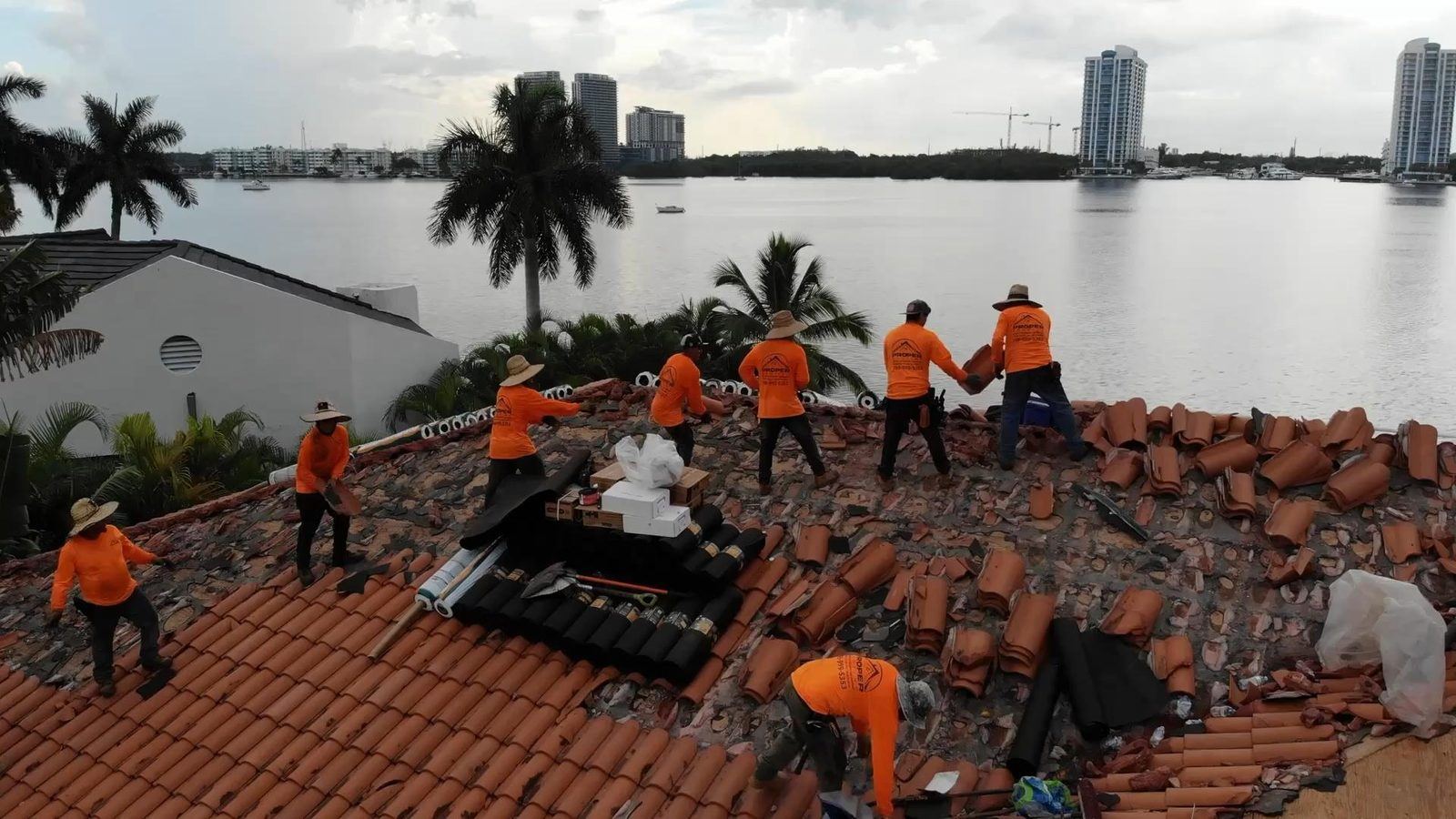
On a typical single-family home the work itself runs about 3–7 working days for tile, often less for shingle or metal, with inspection scheduling adding a day or two between steps. A roof is not finished when the crew leaves; it is finished when the final inspection is approved and the permit shows as closed. Our roof replacement process schedules every inspection and hands you the closed permit and NOA package.
What permits typically cost
Fees are set by each department and are usually figured on the roof area. As one public example, the City of Miami Gardens' roofing fee sheet (revised December 2020) charges $0.14 per square foot of roof for shingle and low-slope roofs and $0.17 per square foot for tile and metal, with a $138.25 minimum; on that schedule a 2,500 sq ft tile roof works out to about $425 before any state surcharges. Other cities and unincorporated Miami-Dade use their own schedules, so a single-family reroof permit typically lands somewhere from a few hundred dollars to around a thousand, more on large or commercial roofs. A professional estimate should include the permit; ask if it is not listed.
Which roof fits the HVHZ: tile, metal, shingle or flat
Every system below can be permitted in Miami-Dade; the differences are weight, lifespan, how it is attached and how it handles sun and salt air. Lifespans are typical ranges for South Florida, not guarantees.
| System | Typical life here | How it's attached in the HVHZ | Sun and salt |
|---|---|---|---|
| Concrete or clay tile | 30–50 years (underlayment every 20–30) | Foam adhesive, mortar or screws per the tile NOA over a self-adhered or hot-mopped underlayment; TAS 106 uplift test at final for adhesive/mortar set | Excellent UV resistance; concrete tile is a good fit for waterfront homes with stainless or coated fasteners |
| Metal (standing seam or 5V) | 40–60 years | Clips and fasteners per the panel NOA over high-temperature underlayment | Reflective finishes cut attic heat; aluminum is the usual choice near salt water, Galvalume steel further inland |
| Architectural shingle | 20–30 years | HVHZ-approved shingle with the nailing pattern in its approval, minimum 2:12 slope | Lowest upfront cost; heat and UV shorten life compared with tile or metal |
| Flat (modified bitumen, TPO, built-up) | 15–25 years | Membrane system per its NOA, with anchor sheet and tin caps inspected before covering | Needs good drainage; reflective cap sheets and coatings help with heat |
The 25% rule, insurance and the wind-mitigation form
Two rules decide whether a damaged roof gets repaired or replaced. The Florida Building Code's long-standing "25% rule" says that when more than a quarter of a roof section is repaired or replaced in a 12-month period, the whole section has to be brought up to current code, which on an older roof usually means replacing it. Since 2022, Florida Statute 553.844(5) carves out an exception: if the existing roof was built, repaired or replaced under the 2007 Florida Building Code or a later edition, only the portion being repaired has to meet the current code. Your permit history is how you prove which side of that line your roof is on, so a closed permit from a 2007-or-later reroof is worth keeping.
Insurance is the other side of the same paperwork. Florida carriers often look hard at roofs past about 15 years old, and a new roof resets that clock. Florida insurers are also required to offer premium credits for wind-resistant construction, documented on the Uniform Mitigation Verification Inspection Form (OIR-B1-1802). Three of its questions are decided on the roof: the roof covering (a permitted covering that meets current code), roof deck attachment, and whether there is a secondary water barrier. A fourth, roof-to-wall attachment (toe nails, clips, single or double wraps), is checked from the attic, and a reroof is the easiest time to document or upgrade it. After the final inspection we hand over the permit, NOAs and photos the wind-mitigation inspector needs; the size of the credit depends on your carrier.
Hurricane season timing
Atlantic hurricane season runs June 1 through November 30. Permitting and scheduling get busier through spring and after any storm, and a roof that is half torn off when a system approaches has to be dried in fast. The calmer months from December through April are typically the easiest time to schedule a planned replacement, get inspections promptly and have the roof closed out before the next season. If your roof is near the end of its life, starting the estimate and permit in winter is the practical move.
Red flags in a roofing bid
- "We don't need a permit for this." A reroof in Miami-Dade needs one. Unpermitted work can cost you insurance credits, complicate a sale and leave you paying for the job twice.
- A roof-over. HVHZ reroofs are built from the deck up so the deck can be re-nailed and inspected. A price that depends on laying new material over the old roof deserves a hard question.
- No NOA numbers on the estimate, or products that do not match the permit.
- Final payment before the final inspection. Tie the last payment to an approved final and a closed permit.
- A license you cannot look up. Verify the contractor's state license at myfloridalicense.com before signing.
If you are comparing bids, we are happy to walk your roof and give you a written scope that lists every product and its NOA, so you can compare like for like. See the cities we serve, how a replacement looks on local housing stock in North Miami Beach, and $0-down financing options including PACE.