
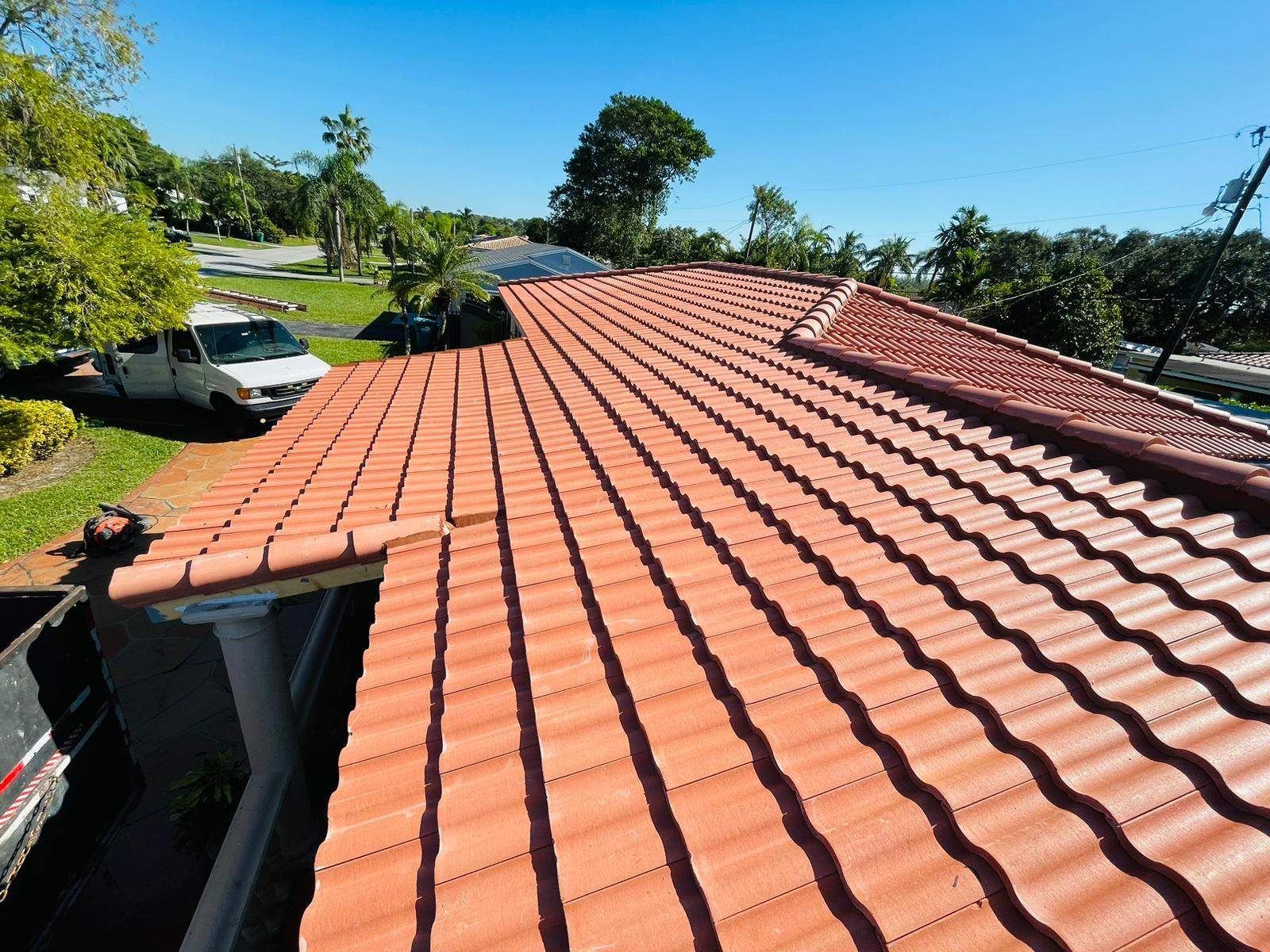
The short version
Most roof leaks in Miami-Dade and Broward come from a short list of places, and the list depends on the roof: on tile it is the underlayment and the flashings, on shingle it is the pipe boots, nail pops and vents, on flat roofs it is ponding water and seams, and on every roof it is whatever was bolted through it later. A repair fixes the one component that failed, with materials that carry a Miami-Dade Notice of Acceptance like the rest of the roof. It is the right answer when the roof underneath still has life in it, and the wrong one when the underlayment is brittle or the leaks keep moving.
This guide lists the ten leaks our roof repair Miami crews find most, how a leak is traced when the stain is nowhere near the hole, what each repair involves and typically costs, the permit threshold, when insurance pays, and what to do tonight if water is coming in.
The ten leaks we find most, by roof type
The numbers below are a rough order of how often each one turns out to be the source on the roofs we inspect, not a statistic. Several of them often show up on the same roof.
Tile roofs
- Worn or torn underlayment under sound-looking tile. Concrete and clay tile shed most of the rain, but the layer that keeps the house dry is the underlayment beneath. On a roof from the 1980s or 1990s that layer is often past its 20-to-30-year life: water gets under a tile, runs down the underlayment and finds a nail hole or a bare patch. One bare patch is a repair. Brittle underlayment across the slope is not.
- Slipped, cracked or missing tiles, and loose hip and ridge mortar. Wind lifts a tile or a satellite installer steps on one; the broken tile lets water onto the underlayment early and often. On older roofs the mortar bedding under hip and ridge caps crumbles and the caps rock loose.
- Headwall and sidewall flashing where the roof meets a wall. Stucco over the flashing, a missing counterflashing or a kick-out left off at the bottom of a wall sends water behind the stucco and into the room below. Two-story homes with a lower roof meeting an upper wall are the usual case.
Shingle roofs
- Split pipe boots. The rubber collar around each plumbing vent is cooked by the sun years before the shingles wear out. It is one of the most common leaks we find and one of the quickest to fix.
- Nail pops and lifted shingles. A nail that backs out lifts the shingle above it and leaves a hole in the one below; a windstorm lifts tabs and breaks the seal strip. Both look minor from the ground and leak in heavy rain.
- Ridge vents, off-ridge vents and gooseneck vents. Loose fasteners, a vent installed without the end plugs, or wind-driven rain entering a vent that faces the storm.
Flat and low-slope roofs
- Ponding water over a blister or an open seam. Water that stands for days after a rain finds the weakest point in the membrane, usually a lap seam or a blister on a modified-bitumen cap sheet. Clogged drains and scuppers make it worse.
- The flat-to-tile transition on an addition. Thousands of 1950s and 1960s homes in Hialeah, Miami Gardens, North Miami and Westchester carry a flat roof over a later addition or enclosed porch. Where that flat section meets the original pitched roof is the single most common leak on those houses.
Any roof
- Valleys. Two slopes drain into one channel, so the valley carries the most water on the roof; once the metal or the underlayment under it wears through, the leak is steady and shows up fast.
- Things attached later: skylights, chimneys, AC stands, solar mounts, satellite dishes and antenna brackets. Anything that was screwed through the roof after it was built depends on whoever sealed it. Skylight curbs and chimney crickets collect debris, and a lag bolt through a tile with a dab of sealant is a leak waiting for the first summer.
The dividing line through all ten is whether the failure is one component or the system. One split boot on a 12-year-old shingle roof is a repair. Three stains in three rooms under 28-year-old tile is the underlayment, and our guide to roof repair versus replacement in Miami covers that decision, the Florida Building Code's 25% rule and its 2007-code exception.
Why the stain is not under the leak
Water enters the roof at the source, then runs downhill along the underlayment, a rafter or the top of the ceiling drywall until something stops it, and that is where the stain appears. On a tile roof the entry point can be ten feet upslope of the stain; on a flat roof it can be on the other side of the room. Patching the roof directly above a stain is why so many repaired leaks come back.
Tracing it properly takes an hour, not a glance from the ladder. We start in the attic when there is one, following the water trail up the decking to the highest wet point with a moisture meter and a flashlight, then check the suspects for that roof type from above. If nothing is obvious, a hose test runs water on one section at a time, starting low and working up, while someone watches inside. Every source is photographed before and after the repair, and the photos go into a written report with the location and the cause, which is what an insurer, a buyer or a future adjuster will ask for.
What a repair actually involves, by leak type
A real repair replaces the failed component with one that carries a current Miami-Dade NOA for the High-Velocity Hurricane Zone, installed the way its approval says. Sealant alone is not a repair on any of the ten above. Costs are typical bands for an ordinary single-family roof, as a guide and not a quote; the inspection and written quote are free.
| Leak | What the repair is | Typical cost band |
|---|---|---|
| Split pipe boot, loose vent | Lift the surrounding shingles or tiles, replace the boot or vent with an NOA-approved one, reseal and reset the covering | A few hundred dollars |
| Cracked, slipped or missing tiles | Match the profile and colour (we keep records of what we install and source discontinued tile through salvage), reset or replace the tiles, re-bed loose hip and ridge caps | A few hundred dollars for a handful of tiles; more when matching is hard or the area is large |
| Nail pops and lifted shingles | Pull or drive the nail, patch the hole, replace torn shingles with matching NOA-approved shingles, re-seal lifted tabs | A few hundred dollars |
| Wall flashing and counterflashing | Remove the covering along the wall, install new step or headwall flashing and a kick-out, cut and reset counterflashing into the stucco, re-cover | Typically higher, into the low thousands depending on length |
| Valley | Strip the covering on both sides, replace the valley metal and underlayment, re-cover and re-seal | Typically into the low thousands |
| Underlayment patch under tile | Lift and stack the tile over the failed area, remove and replace the underlayment, reset the tile per the NOA attachment method | The most expensive repair; a large area is usually the point where replacement makes more sense |
| Flat-roof seam, blister or ponding | Cut out and patch the membrane with matching modified bitumen or TPO, clear or add drains and scuppers, add tapered insulation where water stands | A small patch a few hundred dollars; drainage work more |
| Skylight, chimney, AC stand or mount | Reflash the curb or cricket, replace failed boots and sealant with the manufacturer's detail, re-cover around it | Varies with the penetration; chimney crickets at the high end |
When a roof repair needs a permit in Miami-Dade and Broward
Smaller than many homeowners expect. Miami-Dade County's published permit-exemption list allows the repair or replacement of a roof covering without a permit only when it is done by a licensed roofing contractor, does not exceed $2,000 in materials and labor, and does not exceed two roofing squares (200 square feet) in extent. A repair past either limit is a roofing permit with inspections, and each city in Miami-Dade and Broward sets its own version of the threshold, so the department that serves your address decides. Our guide to Miami-Dade roof permits and NOAs explains how the permit and inspection sequence runs when a repair crosses the line.
Permit or not, the materials rule does not change: in the High-Velocity Hurricane Zone the replacement tile, underlayment, cap sheet, flashing metal and the foam or mortar that sets a tile must carry a current Miami-Dade NOA, and the estimate should name them. Unpermitted work that should have been permitted also weakens the 2007-code exception to the 25% rule, because there is no record of the repair having met code.
What moves the price
- The leak type, as in the table: a boot is a small job, a valley or a wall flashing is a day's work for two roofers.
- Pitch and height. Steep tile and two-story roofs need more staging and more care to walk without breaking tile.
- Matching. A current tile profile is in stock; a discontinued 1990s blend means salvage tile, a close match or tile moved from a hidden slope.
- Decking. Dark, soft plywood under the leak is replaced by the sheet, and a leak that has run for years often has some.
- Timing. The weeks after a named storm are the slowest and most expensive time to get on any schedule in South Florida.
Repairs are quoted after the inspection, never over the phone, and if the honest answer is a new roof, the replacement quote comes with the same photos and a scope listing every product and its NOA.
When insurance pays for a roof leak
A standard Florida homeowner's policy covers sudden, accidental damage from a covered peril, such as wind tearing tile off during a storm, and the interior damage that follows. It does not cover wear and tear: a sun-split boot, crumbled mortar or 25-year-old underlayment is a repair you pay for. Most of the ten leaks above fall on the maintenance side unless a storm caused them, which is why the dated photos from the inspection matter.
Three rules shape a roof claim in Florida today. First, the clock: under Florida Statute 627.70132, notice of a new property-insurance claim must reach the insurer within one year of the date of loss, and a supplemental claim within 18 months, so a leak traced in spring to last fall's storm is already on a deadline. Second, your duty to mitigate: policies require reasonable steps to prevent further damage once you know about it, which is what an emergency tarp is, and the reasonable cost of that temporary measure is typically part of the claim, so keep the invoice and the photos. Third, assignment of benefits: for residential policies issued on or after January 1, 2023, Florida Statute 627.7152 no longer allows a contractor to take over your claim, so a roofer who asks you to sign your benefits over in exchange for a "free" roof is offering something the law does not permit. We document the damage and meet the adjuster on site; the claim stays yours.
A repair does not change your wind-mitigation form; a replacement earns a new inspection and the credits that come with it, which our insurance savings calculator estimates.
If water is coming in tonight
- Move furniture and electronics, put a bucket under the drip, and if the ceiling is bulging with water, puncture the low point so it drains into the bucket instead of bringing the drywall down.
- Photograph everything, inside and out, before anything is cleaned up.
- Do not go on the roof. Wet tile is slick and breaks underfoot.
- Call a roofer for an emergency tarp. Our crews are on site within 3 hours across Miami-Dade and Broward; a tarp is a temporary dry-in, not a repair, and it buys time to document the damage, start the claim and match the materials.
- Verify any contractor's license at myfloridalicense.com before signing anything, and never sign an open-ended contract on the doorstep after a storm.
Hurricane season runs June 1 through November 30: a leak found in May should be repaired before it, and one you have been watching through the summer should be fixed in the calm months after it. How a repair call runs on the Broward side is on our Hallandale Beach roof repair page, and the point where repairs give way to a new roof on 1950s block homes is on the North Miami roof replacement page. Either way, the same Miami roofing company that repairs the leak can replace the roof, which is the only way to get an answer with no reason to lean either direction. Contact us for a free leak inspection.