
The short version
Most real kitchen and bathroom remodels in Miami-Dade need a building permit, and most homeowners find that out at the wrong moment: when a contractor says "we don't need one," when the condo board asks for the permit number, or when a buyer's title company runs a permit search a week before closing. The rule itself is simple. Replacing finishes in the same spot is cosmetic. Moving a sink, a drain, a circuit, a wall or an exterior opening is construction, and construction is permitted and inspected.
This guide covers where that line sits in Miami-Dade and its cities, what a condo association adds on top, the inspections a remodel goes through and in what order, what permits typically cost and how long they take, how an unpermitted or unclosed job shows up at resale and refinance, and how we schedule a kitchen or bath around it.
Cosmetic or permitted: where the line is
The Florida Building Code requires a permit to construct, alter, repair or replace a building or its plumbing, electrical or mechanical systems, and each building department publishes the short list of work it exempts. For a kitchen or bath, the two lists that matter most in our area are Miami-Dade County's, which applies to unincorporated addresses, and the City of Miami's. The cities we work in most, such as Hialeah, North Miami Beach, Aventura and Sunny Isles Beach, each run their own building department and keep their own exemption list, and they read much the same way.
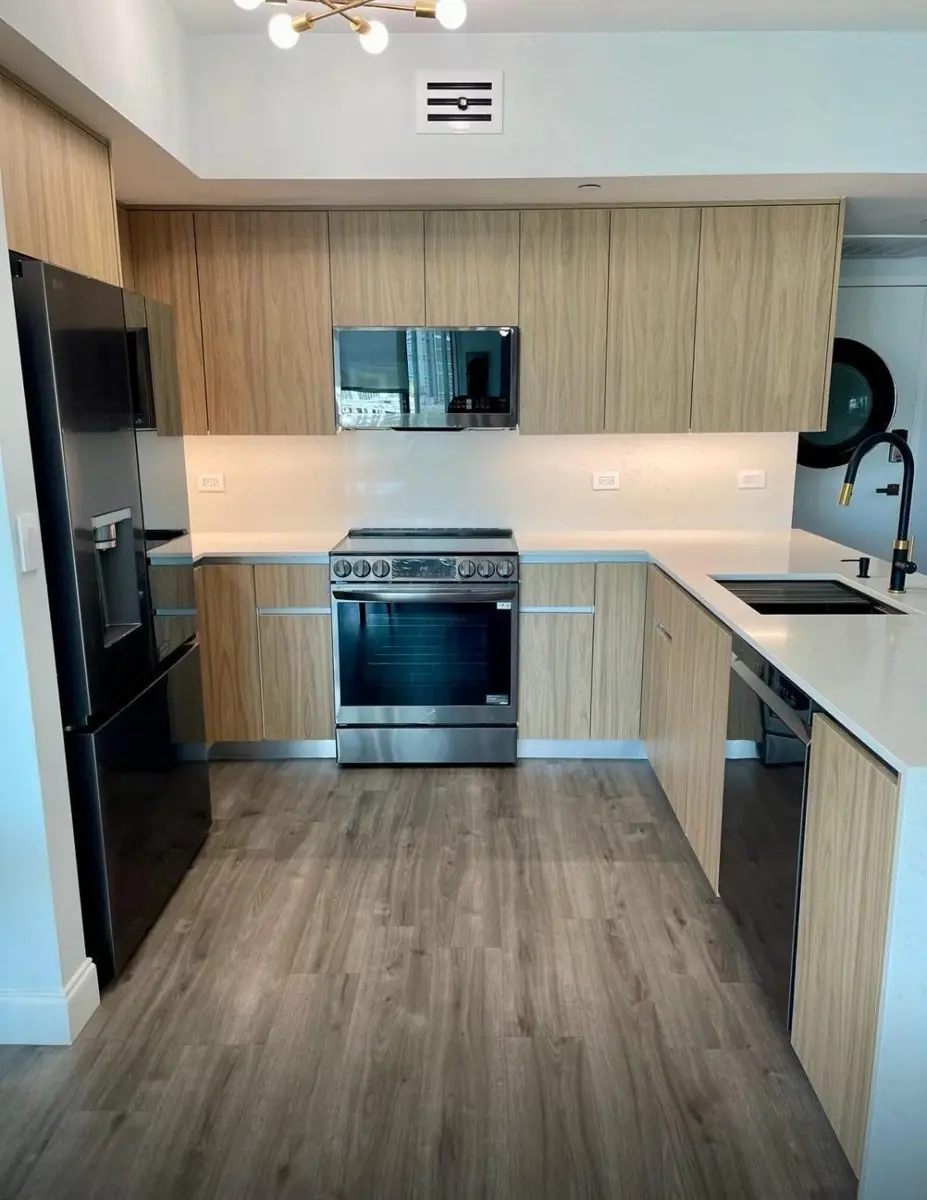
Miami-Dade County's permit exemptions list exempts kitchen cabinets, vanities and paneling installed inside residential units, surfacing floors with tile, carpet or wood, and interior painting, with one line attached to the cabinet item that decides most projects: any associated plumbing, ventilation and electrical work may require a permit. On the trade side, a licensed plumber may replace a faucet, a toilet or a sink fixture, or a residential dishwasher or disposal, without a permit, and a licensed electrician may replace a wall switch or a 20-amp, 120-volt receptacle in place. The City of Miami's list allows cabinets and countertops in single-family homes and duplexes as long as no plumbing lines, wiring or load-bearing walls change, and like-for-like fixture swaps that do not reroute plumbing.
A 2026 state law (HB 803, effective July 1, 2026) adds a further exemption for some single-family work valued under $7,500, but it excludes electrical, plumbing, structural, mechanical and gas work, and it does not apply in a flood hazard area, which rules out most of the county and most real remodels. The City of Miami issues a written exemption approval under it that has to be posted on site before work starts, so even an exempt job can need paperwork. When in doubt, ask the department that serves your address before the demo, not after.
| Work | Permit? | Why |
|---|---|---|
| Paint; new cabinets, vanity or countertop on the same footprint; new tile floor over the slab; swapping a faucet, toilet, sink or dishwasher like for like | Usually no | On the county and city exemption lists when no plumbing line, circuit or wall changes; fixture swaps by a licensed trade |
| Moving the sink, adding an island with a sink or dishwasher, relocating the range or the fridge water line | Yes: building plus plumbing and electrical sub-permits | Drain, vent and supply lines are rerouted; a new circuit or outlet is added |
| Tub-to-shower conversion, moving the toilet, a second bathroom | Yes: building plus plumbing and electrical | The drain moves; new shower waterproofing; usually a new GFCI circuit and exhaust fan |
| New circuits, panel work, under-cabinet or recessed lighting on a new circuit, a 240V line for a range | Yes: electrical | Any wiring beyond replacing a device in place |
| Removing or opening a wall, enlarging a doorway, relocating a window | Yes: building, often with engineered drawings | Structure; an exterior opening in the HVHZ also needs an approved impact product |
| Replacing an exterior window or door during the remodel | Yes: building | In the High-Velocity Hurricane Zone every opening needs an impact-rated product with a Miami-Dade NOA (see our impact windows guide) |
Who issues the permit
Unincorporated Miami-Dade addresses are permitted by the county's Department of Regulatory and Economic Resources; a home inside a city is permitted by that city's building department (the City of Miami, Hialeah, North Miami Beach, Aventura, Sunny Isles Beach and so on). Your property-tax bill or the county property search shows which one applies. The application is filed by the contractor under their license, with floor plans showing the existing and proposed layout, plumbing and electrical drawings when those trades move, and for structural changes an engineer's drawings. A homeowner can also pull an owner-builder permit on their own home, but the county has the owner sign a form taking on the contractor's responsibilities, and the state exemption is for a home you are not building to sell, so selling within a year of completion is treated as evidence it was; for a job with licensed trades in it, a licensed general contractor pulling the permit is the normal route.
Two state rules shape the calendar. Under Florida Statute 553.792, a department has 5 business days to tell you an application is incomplete and 30 business days to approve, deny or request more information on a single-family application under 7,500 square feet, and it must cut the permit fee 10 percent for each business day it runs over; a resubmittal gets 10 business days. And according to Miami-Dade County's homeowner permit information, an issued permit is valid for 180 days and expires if the work does not start or an approved inspection does not occur within that window; a 180-day extension can be requested, and a revision does not extend the date. A Notice of Commencement is recorded for improvements over $5,000, one per permit.
Condo units: what the association adds
In a condominium the city permit is only half the paperwork. Before the building will let a crew in, the association has to approve the work, most departments ask for that approval with the permit application, and the association's package is usually longer than the city's. What most Miami-Dade and Broward buildings ask for:
- An architectural or alteration application with the scope, drawings and finish schedule, reviewed by the board or management; the declaration and rules say what needs approval, and anything touching a common element (the plumbing stack, electrical riser, exterior wall or window) always does.
- A licensed, insured general contractor with a certificate of insurance naming the association, and the trade licenses for plumbing and electrical.
- Flooring rules such as a sound-attenuation underlayment under hard flooring, and weight limits that matter for stone islands and freestanding tubs on an upper-floor slab.
- Logistics: elevator reservation and padding, loading-dock times, allowed work hours and days, where debris goes, and protection of corridors.
- Water shut-offs scheduled with the building, since a tub-to-shower conversion or a moved sink usually means tying into a stack that serves the units above and below.
We prepare that package with the permit application so the two move together; the Sunny Isles Beach kitchen page shows what a tower unit remodel looks like in practice. The one timing rule that helps most: have the association's approval in hand before ordering cabinets, because the lead time on cabinets and stone, not the permit, is usually the long pole.
Inspections, in order
A permitted remodel is inspected at the points where the next step would hide the work. The names vary a little from one department to another, but the sequence is close everywhere:
- Demolition and rough-in. Once the room is down to block and studs, the plumbing rough inspection checks the new drain, vent and supply lines before they are closed in; on a slab house a moved drain means a cut in the slab that is inspected before it is patched. The electrical rough inspection checks boxes, circuits and wiring in the open walls.
- Framing and structure. Where a wall moves or an opening is enlarged, the framing (and any beam or header on the engineer's drawing) is inspected before drywall.
- Shower pan. Most departments inspect the shower waterproofing with the pan flooded before tile goes on; it is the one step that decides whether the bathroom below or the next room stays dry.
- Drywall and insulation where required, then tile, cabinets, counters and fixtures.
- Finals. Plumbing final (fixtures connected, no leaks), electrical final (devices, GFCI and arc-fault protection, lighting), and the building final that closes the permit.
A permit is closed when the last final is approved and the department records it; that record, not the contractor's invoice, is what proves the work was done to code. We schedule inspections so the crew is never waiting more than a day, and hand you the closed permit with the warranty paperwork at the walkthrough.
What permits typically cost, and how long the job takes
Permit fees are set by each department. For interior work they are generally figured from the value of the job, with the plumbing, electrical and mechanical sub-permits each carrying their own minimum, plus state surcharges and a Notice of Commencement recording fee. For a kitchen or bath with two trades moving, the package typically comes to a few hundred dollars, more where an engineer's drawings and a structural review are involved; it should appear as a line on the estimate, and a quote that leaves it off deserves a question. Plan review runs from days to a few weeks depending on the department and the season, and the state deadlines above put an outer limit on it.
On site, a typical kitchen runs 4–8 weeks once cabinets and stone are in hand, and a bathroom 2–4 weeks once tile and fixtures are, with the frameless glass measured after tile and arriving about two weeks later. The permit and the materials run in parallel: we file the application as soon as the design is signed, order cabinets and tile, and schedule demo for the week the permit and the deliveries line up so you are not without a kitchen longer than needed. Pulling the roof and the remodel together, under one mobilization and one permit package, is often cheaper than two separate projects, and we quote it that way on request.
Unpermitted and open permits at resale and refinance
Unpermitted work surfaces at two moments: a sale and a refinance. Florida law requires a seller to disclose known defects that materially affect value and are not readily observable, buyers' inspectors in Miami-Dade routinely compare the house to the permit record, and title companies run a municipal lien and permit search before closing. A kitchen that was moved without a permit, or a permit that was pulled and never closed, shows up in that search, and the usual outcomes are a price concession, a demand that the seller legalize the work before closing, or a lender that will not fund until it is resolved. The same search runs on a refinance.
Legalizing it means an after-the-fact permit: the department reviews the work as built, often with an engineer's letter or opened walls so the inspector can see what was hidden, and departments charge more for a permit issued after work began. Florida's open-permit law (Florida Statute 553.79, effective October 2019) softened the worst cases: a department may close a permit six years after issuance when it finds no apparent safety hazard, may not penalize an arm's-length buyer merely because a previous owner's permit was never closed, and lets an owner close an expired permit by bringing back the original contractor or hiring a licensed replacement, with the department limited to a single search fee for identifying the open permits on a parcel. None of that makes unpermitted work cheaper than permitting it the first time; it only means an inherited problem has a path out.
Before you buy a remodeled house in Miami-Dade, or sell one, pull the permit history from the department that serves the address. Most publish it online by folio number, and it takes minutes.
Paying for it
Kitchens and bathrooms are the one category of our work that Florida's PACE program does not cover, since PACE is limited to hurricane-hardening and energy improvements such as a new roof or impact windows. For interiors we offer GoodLeap and Service Finance loans with fixed rates from 2.99% APR, 5–20 year terms and $0 down; both are laid out on our financing page. The price itself is driven by the cabinets and stone, by how far the plumbing and electrical move, and by whether the panel has the capacity for new circuits, so a written scope that names each of those is the only quote worth comparing.
Start with the remodeling page to see finished kitchens and bathrooms, or the Hialeah bathroom page for a tub-to-shower conversion in a 1950s CBS home, then book a free consultation.