
The short version
In Florida, the age of your roof is now one of the first things a homeowners insurer asks, and in Miami-Dade and Broward it is often the reason a policy is not renewed. Since the state's 2022 insurance reform, an insurer may not refuse to write or renew a policy solely because a roof is under 15 years old. Once the roof passes 15, the carrier may ask about its condition, and the homeowner has the right to answer with an inspection showing the roof has at least five years of useful life left. A permitted roof replacement resets that clock and earns wind-mitigation credits on the hurricane portion of the premium.
This guide covers what the rule does and does not say, the two inspection forms that decide the price and the renewal, what to do after a non-renewal letter, where repair stops being an option, and how to pay for the work. It is plain language, not legal advice; your agent and your policy are the final word on your own coverage.
Why Florida insurers care how old your roof is
The roof is the part of a Florida house that fails first in a hurricane and produces the most claims between hurricanes: a 20-year-old shingle roof that loses tabs in a summer squall, or a 25-year-old tile roof whose underlayment gives up, becomes a water-damage claim far larger than the roof. After years of losses and carriers leaving the state, the Legislature passed two reform bills: Senate Bill 2-D in the May 2022 special session, which wrote the roof-age rule into the insurance code and re-funded the My Safe Florida Home program, and Senate Bill 2-A in December 2022, which among other changes shortened the window for reporting a claim to one year and ended assignment-of-benefits contracts on new policies.
For a homeowner in Miami Gardens, Miramar or North Miami Beach the practical effect is simple: the insurer wants the year the roof was permitted, what it is made of, and whether it was built to the current code. All three sit in the public permit record, which is why a permitted re-roof matters more than a receipt.
What the 15-year rule actually says
The rule is in Florida Statute 627.7011, as amended by SB 2-D. In plain terms:
- Under 15 years: an insurer may not refuse to issue or renew a homeowners policy solely because of the roof's age if the roof is less than 15 years old.
- 15 years and older: the insurer must allow the homeowner to have the roof inspected before refusing to write or renew on the basis of age. If that inspection shows the roof has five or more years of useful life remaining, the insurer may not refuse to write or renew the policy solely because of the roof's age.
Three things the rule does not do. It does not stop an insurer from declining a roof that is leaking, patched or at the end of its life at any age; the protection is against age alone. It does not set the price: a 16-year-old roof that passes can still be rated higher than a new one. And it leaves the inspector and the form to the carrier. In practice the inspection is done by a licensed roofing contractor, home inspector, general contractor, engineer or architect, and the report covers the covering, the deck as seen from the attic, flashings and penetrations, prior repairs, evidence of leaks and the permit history. Ask your agent which inspectors the carrier accepts before you order one.
What a roof needs to pass at 15 to 20 years
A shingle roof at 15 years in South Florida sun is usually short on granules, with lifted or cracked tabs at the eaves and ridge; whether it has five years left depends on how much of that is cosmetic. A tile roof at 20 years looks fine from the street, and the question is the underlayment beneath it, checked at the eaves, at slipped tiles and from the attic. The flat section over a carport or Florida room is often the oldest part of the roof and the one that fails. Unpermitted repairs and a second layer of covering are hard to defend to any carrier.
The two inspection forms that matter
Two documents decide most of what a Florida insurer thinks about your roof. They are different things and are ordered for different reasons.
| Wind-mitigation inspection (OIR-B1-1802) | 4-point inspection | |
|---|---|---|
| What it is | The state's Uniform Mitigation Verification Inspection Form: the features of the house that reduce hurricane damage | An insurer's form, not the state's: condition and age of the roof, electrical, plumbing and HVAC |
| Why it is ordered | To earn the premium discounts Florida law requires for those features | To decide whether the carrier will write or renew an older home at all |
| Who performs it | A licensed contractor, engineer, architect, building inspector or qualified home inspector | A licensed home inspector or contractor the carrier accepts |
| What a new roof changes | Earns the roof covering, deck attachment and secondary water barrier credits | The roof section passes with the permit year, the material and the remaining life stated |
| How long it lasts | Five years, after which the insurer may ask for a new one | Set by the carrier, often at each renewal for older homes |
The credits a new roof earns
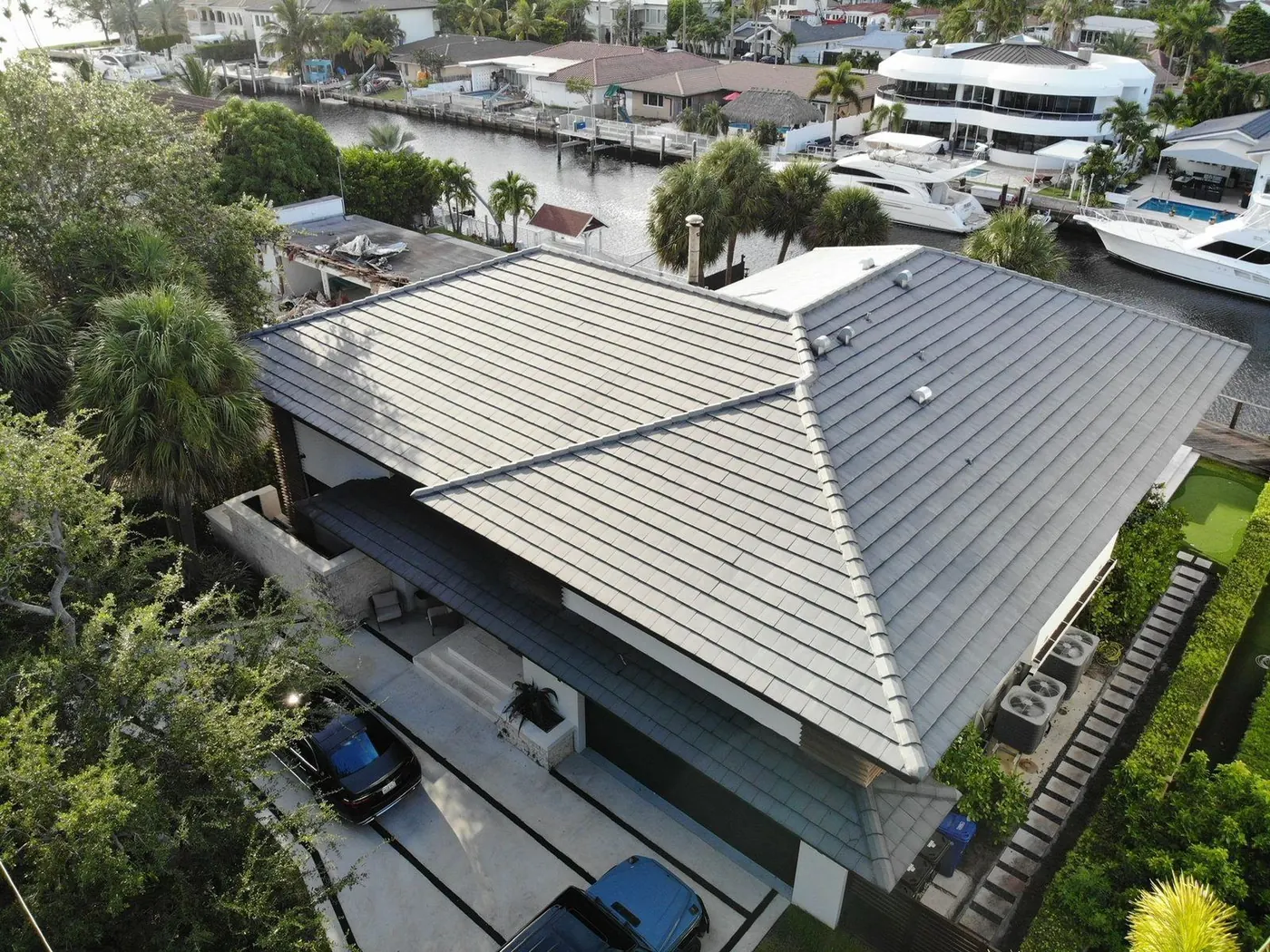
The wind-mitigation form has seven parts: the building-code year, roof covering, roof deck attachment, roof-to-wall connection, roof shape, secondary water resistance and opening protection. A roof replacement in Miami-Dade or Broward changes three. The roof covering qualifies when it was permitted to the Florida Building Code, which here means the High-Velocity Hurricane Zone and Miami-Dade NOA products. The roof deck attachment qualifies when the sheathing is re-nailed to the current schedule, checked by the building inspector before the dry-in. The secondary water resistance credit comes from the self-adhered underlayment over the whole deck. A hip roof like the one in the photo earns the roof-shape credit on its own; a gable roof does not, and a re-roof does not change that.
Florida's discounts apply to the hurricane portion of the premium, not the whole bill, and each carrier files its own schedule, so two companies can rate the same house very differently. The insurance savings calculator shows the published ranges and the state sources behind them, and the Office of Insurance Regulation's wind-mitigation resources page has the form itself. Order the inspection after the final roof inspection passes, not before, so the report shows the new covering and the closed permit.
The week the non-renewal letter arrives
Florida requires written notice of non-renewal on a residential policy well before the expiration date, which leaves time to act if you use it:
- Read the reason. If the letter says roof age or condition, it usually also says what would change the decision: an inspection, a repair or a replacement by a date. Note that date.
- Call the agent the same day. Ask whether the carrier accepts a roof condition inspection under the 15-year rule, which inspectors it recognizes, and whether a replacement before the expiration date would reinstate the renewal or require a new application.
- Get the roof inspected within the week. Our roof repair Miami inspection is free and comes with a written condition report and photos. If the roof has five years in it, that report is what goes to the carrier. If it does not, you will know early enough to replace it before the deadline.
- If the answer is replacement, permit first. A permitted re-roof takes a permit review by your city or the county, a few days to a week on the roof and a final inspection, so working back from the expiration date the contract needs weeks to spare. A contractor who takes more than 10% up front must apply for the permit within 30 days under Florida Statute 489.126.
- Shop the policy as well. A new roof with a fresh wind-mitigation report is a different application. Citizens Property Insurance, the state-created insurer of last resort, is there when no private carrier will write the home at a comparable premium, and it follows the same statute. Ask the agent to quote more than one carrier once the roof is done.
After the final inspection we hand over the closed permit, the NOA list, the registered manufacturer warranty and the photos; the checklist at the end of this guide lists each item.
Repair or replace at 15 to 20 years
A non-renewal letter does not always mean a new roof. If the roof is sound and the leak is local, a documented repair and a condition report are often enough. Three things push the answer toward replacement: the Florida Building Code's 25% rule, under which repairing more than a quarter of a roof section within 12 months means bringing the whole section to current code (with an exception in Florida Statute 553.844 for roofs built under the 2007 code or later); brittle underlayment under tile, which tears whenever a tile is lifted; and granule loss and cracking across a whole shingle roof rather than in one spot. Our guide to repair versus replacement and the 25% rule walks through that decision; this guide does not repeat it.
If the roof is going to be replaced within the policy year anyway, replacing it before the renewal is usually the better order: the application goes in with a new roof, the wind-mitigation credits apply from the first premium, and the 15-year clock starts over. What a roof replacement Miami includes in the hurricane zone, and what it typically costs per square, is on the service page and in our guide to roof replacement cost in Miami.
Paying for it: the state grant, PACE and financing
- My Safe Florida Home. The state program re-created by SB 2-D offers a free wind-mitigation inspection to owners of homesteaded single-family, site-built homes, and matching grants toward improvements the inspection recommends, with a larger share covered for lower-income households. Which improvements qualify, the insured-value limit and whether funding is open change with each legislative session, so check mysafeflhome.com before counting on it. The inspection alone is worth having: it is the same OIR-B1-1802 report an insurer uses.
- PACE, $0 down on the property-tax bill. Under Florida's PACE statute a hurricane-resistant roof can be financed as a non-ad valorem assessment repaid with your property taxes: no minimum credit score, a fixed rate set at signing, 10–20-year terms. Proper Roofing is an approved contractor with Florida PACE and Renew Financial.
- Loans from 2.99% APR. GoodLeap and Service Finance loans start with a soft credit pull and run fixed rates typically from 2.99% to 13.45% APR over 5–20 years. The financing page explains how each path qualifies and repays.
- Insurance after storm damage. A standard policy covers sudden damage from a covered peril such as wind, not age or wear. If this season damaged the roof, notice of the claim must reach the insurer within one year of the loss.
Checklist: what to send your agent after a new roof
- The permit number and the building department's final inspection approval, which together establish the permit year the carrier records.
- The contractor's licence number on the permit. Ours is Florida Certified Roofing Contractor CCC1331964; any contractor's can be checked at myfloridalicense.com.
- The NOA list: the Miami-Dade Notice of Acceptance for the covering, the underlayment, the drip edge, the adhesive or fasteners and the vents.
- The wind-mitigation inspection form (OIR-B1-1802), ordered after the final inspection.
- Photos of the re-nailed deck, the self-adhered underlayment and the finished roof, which we take at each stage.
- The registered manufacturer warranty and our workmanship warranty, in writing.
Hurricane season runs June 1 through November 30. If the roof is at 15 years and the renewal falls in spring, December through April is the time to have it inspected and, if needed, replaced, with the paperwork in the agent's hands before the season starts. Our guide to how to choose a roofing company in Miami covers the checks to run on any roofers in Miami before you sign, the permit and NOA guide explains each inspection the carrier later sees in the record, and how this plays out on the 15–20-year-old shingle roofs of north Miami-Dade is on our Miami Gardens roof replacement page.