
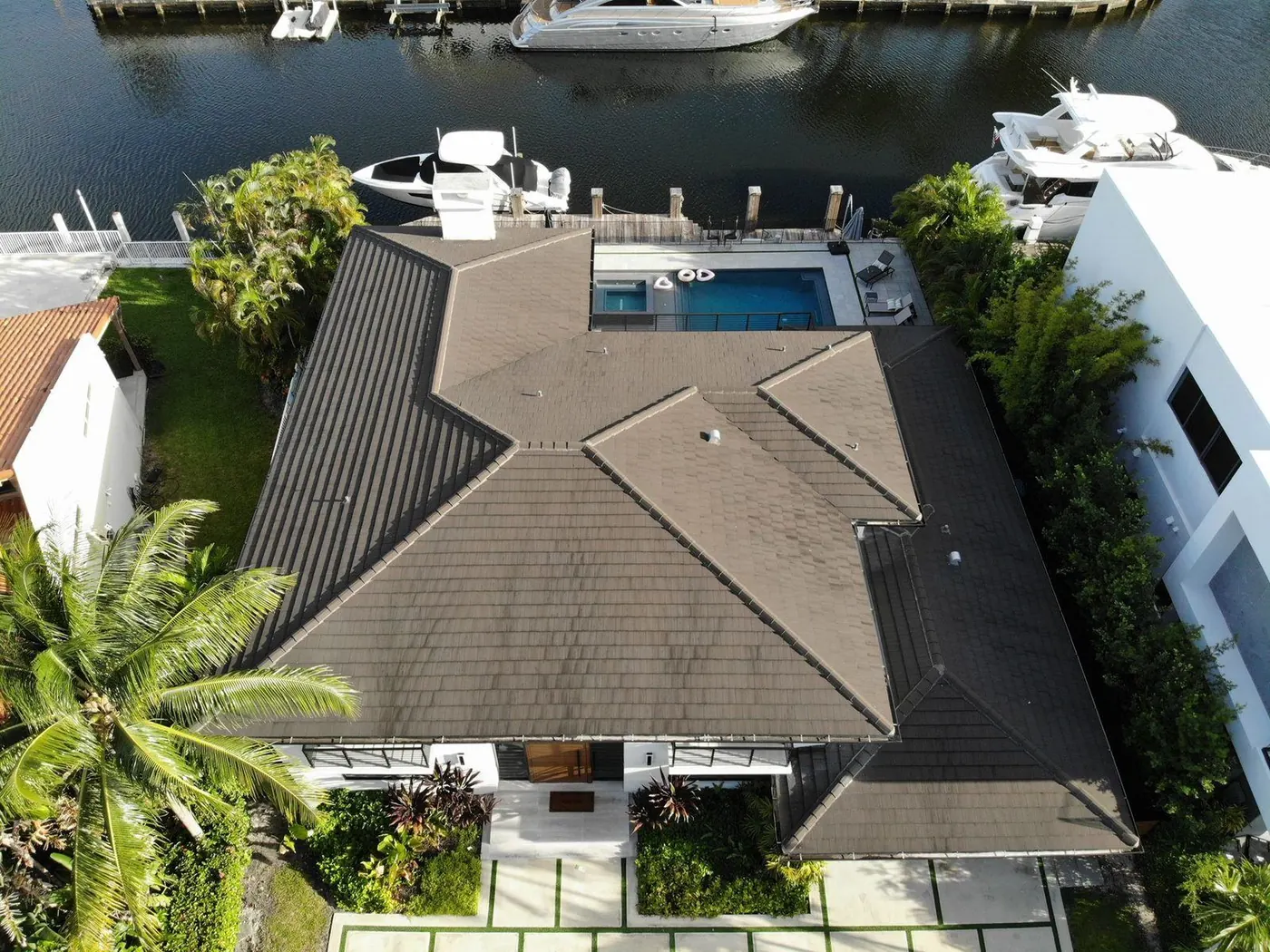
The short version
A roof replacement in Miami is priced per square, and a square is 100 square feet of roof surface. The ranges our instant roof quote applies to a satellite measurement of your roof are typically $470–$750 per square for architectural shingle, $850–$1,400 for concrete or clay tile, $950–$1,600 for standing-seam metal and $500–$850 for flat or low-slope sections, installed, permitted and inspected in the High-Velocity Hurricane Zone. Where a house lands inside its range depends on things that are on the roof, not in the brochure: pitch, how cut-up the roof is, the plywood under the old covering, stories and access, flat sections, and the permit fee set by your city.
This guide shows you how to count your own squares, what each of those items does to the price, how lifetime cost differs from the quote, what comes back through wind-mitigation credits, how to pay for it, and how to read a quote line by line so two bids can be compared like for like. It covers Miami-Dade and Broward; the same code applies in both.
What a roofing square is, and how to estimate your own roof
Roofers measure in squares because material is sold that way: a square is 100 square feet of roof surface, measured on the slope, not the floor plan. The footprint of the house understates the roof for two reasons. Pitch adds surface: a roof that rises 4 inches for every 12 inches of run has about 5% more surface than its footprint, a 6:12 pitch about 12% more and an 8:12 pitch about 20% more. Overhangs add more: the eaves extend past the walls on every side, so a house with 1,800 square feet of living area can carry 2,200–2,600 square feet of roof once the pitch and the overhangs are counted.
A rough count at home: take the footprint of the house including the garage and covered porches, add the overhangs, multiply by the pitch factor, and divide by 100. A 2,000 sq ft footprint with 2-foot eaves and a 5:12 pitch comes to roughly 25 squares. That is good enough to sanity-check a bid. The quote itself is built from a measurement: the instant roof quote measures the roof from satellite imagery and emails the size in square feet and squares with a price range for each system, and the on-site inspection confirms it before anything is written down.
Per-square ranges by roof system
These are the ranges our instant quote uses today. They are typical installed ranges for an ordinary single-family roof in Miami-Dade and Broward, including tear-off, deck re-nailing, the self-adhered secondary water barrier, NOA-approved components, the permit and all inspections. They are not a quote; the written price follows the inspection.
| Roof system | Typical per square (100 sq ft) | Rated life in South Florida | Where it usually goes |
|---|---|---|---|
| Architectural shingle | $470–$750 | 20–30 years | The 1950s–70s one-story block houses of north Miami-Dade and south Broward, usually on their second or third roof |
| Concrete or clay tile | $850–$1,400 | 30–50 years; underlayment replaced every 20–30 | The classic Miami roof, and nearly all of the 1990s–2000s subdivisions in western Broward |
| Standing-seam metal | $950–$1,600 | 40–60 years | Waterfront and modern homes; aluminum within reach of salt air, Galvalume steel inland |
| Flat and low-slope | $500–$850 | 15–25 years | Additions, carports and Florida rooms, done on the same permit as the pitched roof |
What that means per house
Multiply the squares by the range. On the 25-square example above, shingle lands roughly between $12,000 and $19,000, tile between $21,000 and $35,000 and metal between $24,000 and $40,000 before any extras, which is the spread you will see across bids for the same house. The instant quote rounds the same math to the nearest $500 for your actual measurement. Flat sections are priced on their own squares at the flat rate and added to the pitched roof, so a house with a 400 sq ft carport roof carries four flat squares on top of its shingle or tile squares.
What moves the price in the hurricane zone
Two houses with the same covering can be a third apart in price. Every quote we write itemizes the reasons, and these are the ones that move the number most:
- Tear-off and disposal. Nothing is laid over an old roof in the HVHZ, because the deck has to be exposed, re-nailed and inspected. Two layers of old shingle or a heavy tile roof means more labor and more dumpster loads.
- Rotten or delaminated plywood, billed by the sheet. A 1960s house on its third roof usually has some. A quote should state the per-sheet price up front so it is never a surprise after tear-off.
- Re-nailing the deck to current code. The existing sheathing is re-nailed to the current schedule, and the building inspector checks it before anything covers it. It is also one of the wind-mitigation credits.
- The self-adhered secondary water barrier. The underlayment over the whole deck is what keeps the house dry if a storm lifts the covering. It costs more than a felt dry-in and it is required for the insurance credit.
- NOA-approved components. In Miami-Dade and Broward the tile, shingle or panels, the underlayment, the drip edge, the foam or mortar that sets a tile, vents, pipe boots and even the fasteners each carry a Miami-Dade Notice of Acceptance for the High-Velocity Hurricane Zone. They cost more than generic parts, and they are what the inspector checks. Our guide to Miami-Dade roof permits, NOAs and the HVHZ explains how to look each one up.
- Pitch, hips and cuts. A steep roof or one with many hips and valleys has more squares, more cuts and more ridge than its footprint suggests, and steep tile takes more staging to walk safely.
- Flat sections and the transition. A carport or Florida-room roof is its own membrane system, and the joint where it meets the pitched roof is flashed by hand. That joint is where most South Florida leaks start, so it is not the place to save money.
- Stories and access. A two-story house, a tight lot or a tile roof that needs a crane to load changes the labor.
- HOA and colour. Gated communities approve the profile and colour; some blends are special-order. We submit the sample board.
- The permit fee. Set by your city or by the county, usually by roof area, so it differs between a Miami Gardens and a Miramar address of the same size; a single-family reroof permit typically runs from a few hundred dollars to around a thousand. The permit guide above has a public fee-sheet example.
Lifetime cost: the quote is not the whole price
The cheapest roof to buy is not always the cheapest roof to own. Shingle costs the least per square and is rated for 20–30 years in South Florida sun; a house that stays in the family may replace it twice in the time a tile roof lasts once. Tile is rated for 30–50 years, but the underlayment beneath it, the layer actually keeping the house dry, has a 20–30-year life of its own, so a tile roof carries a mid-life cost: the tile is lifted, the underlayment replaced and the tile reset per its NOA. Metal is rated for 40–60 years with a Kynar 500 finish that holds its colour under full sun, and it is the lightest of the three, so a 1960s truss roof carries no new load. Flat membranes are rated for 15–25 years and are usually redone along with the pitched roof above them.
Divide the installed price by the years you expect from it and the order often flips. Our guide to the best roof type for a Miami-Dade home compares the systems by neighborhood era, weight and insurance credit, and the metal roofing guide draws the aluminum-versus-Galvalume line by distance from salt water.
What comes back: insurance credits and the 15-year rule
A roof installed to today's Florida Building Code earns credits on the Uniform Mitigation Verification Inspection Form (OIR-B1-1802) for the code-compliant roof covering, the upgraded deck attachment and the secondary water barrier, on top of whatever a hip shape, hurricane straps and impact-rated openings already earn. Florida's discounts apply to the hurricane portion of the premium, not the whole bill, and the insurer sets the actual number from a wind-mitigation inspection after the roof is finished. The insurance savings calculator shows the published ranges for your house and where the credits come from, with the state sources it is built on.
Roof age is the other side. Since Florida's 2022 insurance reform (SB 2-D), a carrier may not refuse to write or renew a policy solely because a roof is under 15 years old; once it passes 15, the homeowner can present an inspection showing at least five years of useful life left. A new permitted roof resets that clock, and after the final inspection we hand over the closed permit, the NOA list and the photos your agent asks for.
The last rule decides whether a repair is still allowed. The Florida Building Code's 25% rule says that when more than a quarter of a roof section is repaired or replaced in a 12-month period, the whole section has to be brought up to current code, with an exception under Florida Statute 553.844 for roofs built or replaced under the 2007 code or later. Many 1990s tile roofs in western Broward and 20-year-old shingle roofs in north Miami-Dade are past the point where a repair is the cheaper answer; our guide to repair versus replacement and the 25% rule walks through that decision.
Paying for it
- PACE, $0 down on the property-tax bill. Under Florida's PACE statute (Section 163.08) a hurricane-resistant roof can be financed through a non-ad valorem assessment repaid with your property taxes: no minimum credit score, a fixed rate set by the PACE provider at signing, 10–20-year terms, up to 100% of the roof. Proper Roofing is an approved contractor with Florida PACE and Renew Financial.
- Consumer loans from 2.99% APR. GoodLeap and Service Finance loans start with a soft credit pull, run fixed rates typically from 2.99% to 13.45% APR over 5–20 years, and cover any project we do, with programs for lower credit scores. The financing page explains how each path qualifies and repays.
- Insurance after storm damage. A standard Florida homeowner policy covers sudden damage from a covered peril such as wind, not wear and tear, so a 25-year-old roof that leaks in a summer rain is yours to pay for while a roof that lost tile in a named storm may be a claim. Notice of a new claim must reach the insurer within one year of the loss. We document the roof and meet the adjuster; the claim stays yours.
How to read a Miami roofing quote
Every quote we write, and every one you should accept, has these eight lines. If one is missing, ask before you sign:
- Licence number on the quote and on the permit. Ours is Florida Certified Roofing Contractor CCC1331964; check any contractor's at myfloridalicense.com, and make sure the permit is pulled under that licence, not a third party's.
- The NOA list. A Miami-Dade Notice of Acceptance number for the covering, the underlayment, the drip edge, the adhesive or fasteners and the vents, each one current on the county's Product Control search.
- Deck re-nail and plywood. Re-nailing to the current code pattern included, with the per-sheet price for replacement plywood stated.
- The underlayment, by name. A self-adhered secondary water barrier over the whole deck, not a dry-in felt.
- Flashings and penetrations. New drip edge, valley metal, wall flashings, pipe boots and vents, and how the flat-to-pitched transition is handled if you have one.
- Permit and inspections. The permit fee included and each inspection scheduled by the contractor: deck nailing, dry-in or tin cap, in-progress and final.
- Two warranties. The manufacturer's registered system warranty and the contractor's own workmanship warranty, both in writing with the years stated.
- The payment schedule. A deposit at signing, a draw at the dry-in or in-progress inspection, and the balance only after the building department approves the final. Under Florida Statute 489.126, a contractor who takes more than 10% of the price up front must apply for the permit within 30 days and start work within 90 days of the permit being issued.
Red flags on a low bid
- No permit, or "we can do it without one". A reroof in Miami-Dade or Broward needs one, and unpermitted work costs you the insurance credits and the 2007-code exception.
- A roof-over. New material laid over the old roof means the deck was never re-nailed or inspected.
- No NOA numbers, or products on the estimate that do not match the permit.
- A large deposit before the permit is pulled, or final payment before the final inspection.
- A price with no squares on it. If the bid does not say how big your roof is, you cannot compare it with anything.
Our guide to how to choose a roofing company in Miami covers the licence check, the insurance certificates and the questions to ask before signing. How a replacement is priced on the one-story block houses of Miami Gardens and on the 1990s tile subdivisions of Miramar is on those city pages.
When to buy
Hurricane season runs June 1 through November 30. Permitting and crews are busiest through spring and after any storm, and a roof half torn off when a system approaches has to be dried in fast. December through April is typically the easiest time to schedule a planned replacement, get inspections promptly and have the roof closed out before the next season. If the roof is near the end of its life, start the roof replacement Miami estimate in winter: the number is the same, the schedule is not. Any Miami roofing company should be willing to walk the roof, measure it, and put every one of the lines above in writing before asking for a deposit.