
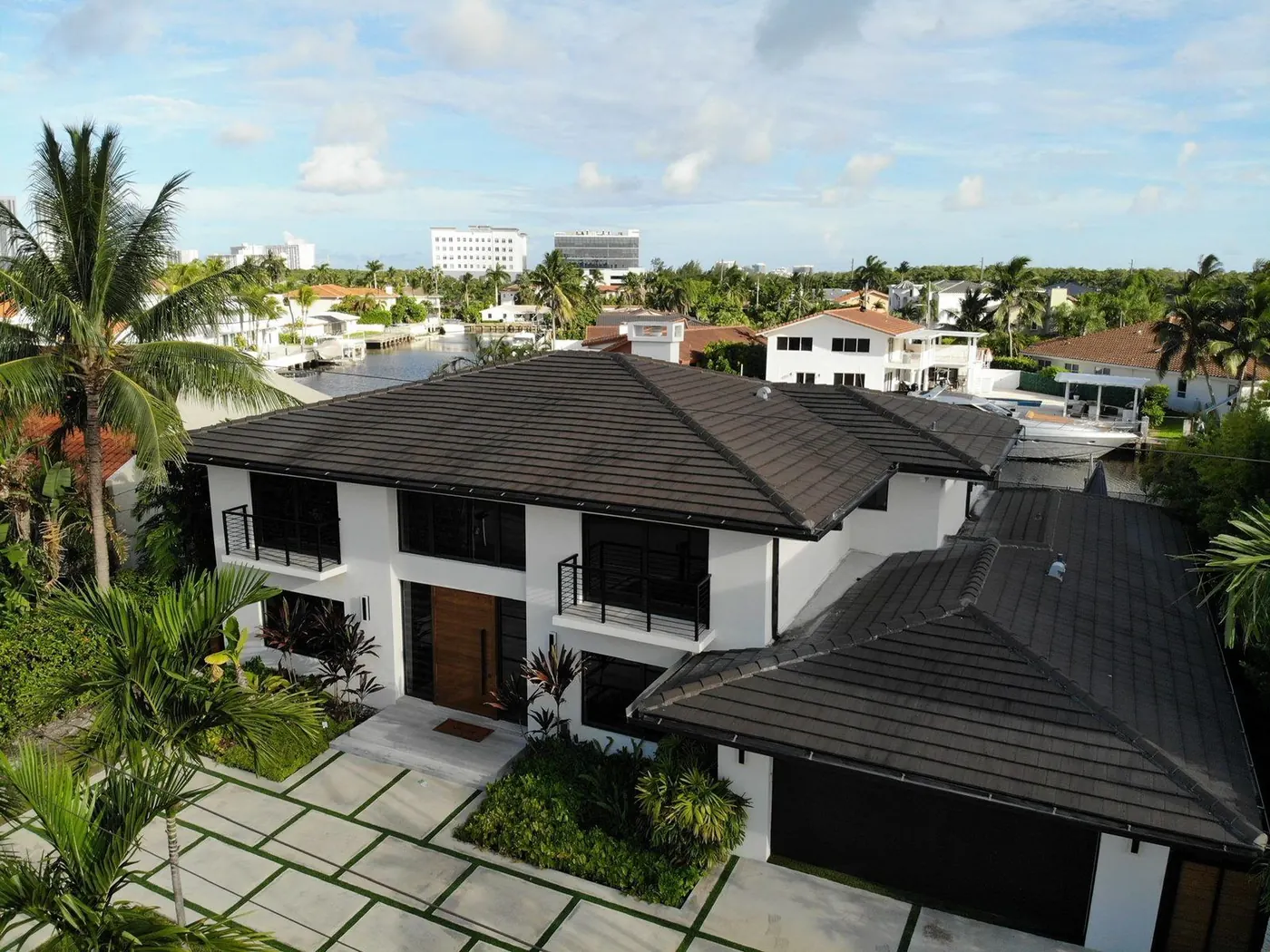
The short version
Four roof systems cover almost every house in Miami-Dade: concrete or clay tile, architectural shingle, standing-seam metal, and a membrane on the flat sections. All four can be permitted anywhere in the county, because the Florida Building Code's High-Velocity Hurricane Zone (HVHZ) does not favor a material; it requires every material to hold a Miami-Dade Notice of Acceptance (NOA) and to be installed the way that approval says. The choice comes down to what your house was built to carry, how close you are to salt water, how long you plan to own it, and what you can spend now versus over thirty years.
This guide covers what is already on Miami-Dade roofs and why, each system's weight, life and weak point, a side-by-side table, the insurance and financing math, and where we have installed each one. The permit and inspection sequence is in our guide to Miami-Dade roof permits, NOAs and the HVHZ.
One county, one wind code, many permit offices
The HVHZ is the whole of Miami-Dade and Broward, so the product and installation rules are identical in Homestead, Doral and Aventura. What changes at every city line is who issues the permit: unincorporated addresses go through Miami-Dade County's Department of Regulatory and Economic Resources, while the county's 34 municipalities, Miami, Hialeah, Miami Gardens, North Miami, North Miami Beach, Miami Shores and Aventura among them, each run their own building department with their own fees and inspection names. The county publishes its roof inspection checklist, and the code itself is at floridabuilding.org. The roof type does not change the rules, and a licensed Miami roofing company pulls permits in every one of those offices every week.
What is on Miami-Dade roofs now, and why
Miami-Dade was built in waves, and each wave left a roof behind. Knowing which wave your street belongs to tells you what your trusses were designed for.
- 1920s–1940s: clay barrel tile. Coral Gables, Miami Shores and the older parts of Miami were laid out in the Mediterranean Revival style, with masonry walls and clay barrel tile. Those houses were built to carry tile, and in historic districts the review board often expects tile back.
- 1950s–1960s: CBS homes with flat or shingle roofs. The post-war boom filled Hialeah, Miami Gardens, North Miami, Westchester and much of unincorporated Miami-Dade with one-story concrete-block houses under low-slope built-up roofs or shingle. Later flat additions and carports are where many of today's leaks live.
- 1980s–2000s: concrete tile. Kendall, West Kendall, Doral and the subdivisions along the Broward line were built with concrete S-tile and flat tile on trusses designed for the weight; many of those original roofs are now at the age where the underlayment fails.
- Condos, apartments and commercial: flat. Modified bitumen, TPO and built-up systems, usually replaced on a reserve-study schedule.
There is no single "Miami roof": the right answer on a 1958 Hialeah ranch is often different from the right answer on a 1995 Kendall two-story.
Tile: the Miami roof, if the structure carries it
Concrete and clay tile do not burn, rot or lose granules, and they shrug off the UV that ages a shingle. A tile roof in Miami-Dade typically lasts 30 to 50 years, clay longer, and the color on a fired clay tile is the tile itself, so it never fades. Tile is also the heaviest roof you can put on a house, roughly nine to twelve pounds per square foot for concrete. Most block-and-truss South Florida homes were built for it; a house that has carried shingle its whole life may need an engineer's letter before tile is quoted.
The part of a tile roof that keeps you dry is the underlayment, and that is what fails, typically after 20 to 30 years for modern self-adhered products. A tile roof that leaks with no cracked or slipped tiles has usually reached that point, and new tile over tired underlayment buys two or three years at most.
Foam, mortar or screws
In the HVHZ each tile's NOA lists the attachment methods it is approved for: polyurethane foam adhesive, mortar, or screws and nails. Foam and mortar set roofs get a field uplift test (TAS 106) at the final inspection; mechanically fastened roofs are checked for pattern and fastener type. We install Westlake Royal concrete tile in the Saxony 900 flat profile, the Barcelona 900 high-barrel S and the Villa 900 and Estate low-barrel S, plus Verea clay Spanish S, all stocked locally so a repair years from now can be matched. Across Miami-Dade we have put tile on homes in ZIPs including 33147, 33155, 33160, 33162, 33165, 33168, 33185, 33193 and 33196; the tile roof Miami page shows the profiles and the portfolio the finished roofs.
Shingle: the lowest-cost HVHZ roof, with a shorter clock
Architectural shingle is the fastest and most affordable way to put a new, code-compliant roof on a Miami-Dade house; most single-family replacements are done in one or two days. The HVHZ does not ban shingle, it regulates it: the shingle must carry a Miami-Dade NOA, the deck must be re-nailed and sealed, the slope must be at least 2:12, and the inspector checks the nailing pattern in the approval, six nails per shingle. The lines we install, GAF Timberline HDZ, Owens Corning Duration, TAMKO Titan XT and CertainTeed Landmark, each hold HVHZ approvals.
What Miami does to a shingle is heat, not rain. Asphalt shingles here typically last 20 to 30 years as a full system, less over a poorly ventilated attic. Shingle is the right answer on a house that never carried tile, on a budget that needs the lowest monthly payment, on a rental or a house you plan to sell within a decade. It is a common choice in the 1950s and 60s neighborhoods: our shingle installs in Miami-Dade include 33056, 33169 and 33179 in Miami Gardens and the North Miami Beach area, along with Hialeah, Westchester, Homestead and Coconut Grove. The shingle roof Miami page shows the four lines and their colors.
Metal: the longest life, chosen by distance from salt water
Standing-seam metal reflects most of the sun's heat, carries the highest wind ratings of any residential roof, weighs roughly a pound to a pound and a half per square foot, and typically lasts 40 to 60 years. The decision inside metal is the metal itself: within about a mile of the ocean, the bay or the Intracoastal, aluminum, because it cannot rust; further inland, 24-gauge Galvalume steel, stiffer and cheaper but with panel warranties that are often limited near salt water. Our guide to metal roofing in Miami walks through that rule, standing seam versus 5V-crimp, and the price drivers.
Metal costs more than shingle up front and overlaps with tile, so it makes the most sense on a waterfront home, a house you intend to keep, or an older structure that wants a long roof without tile's weight. We have installed standing-seam metal in Miami-Dade in 33160, 33165 and 33176; the metal roof Miami page shows the aluminum and Galvalume systems and the 38 Kynar 500 colors.
Flat and low-slope: fix the drainage, then choose the membrane
Many Miami-Dade houses have at least some flat roof: an addition, a carport, a garage or a Florida room. Membranes, usually two-ply modified bitumen with a granulated cap sheet on homes and TPO single-ply on larger commercial roofs, typically last 15 to 25 years, and most early failures are drainage failures wearing a membrane's clothes: water still standing two days after rain finds every seam. So the first question on a flat roof is slope, drains and scuppers, and where the deck is dead flat the fix is tapered insulation or crickets, not a thicker membrane.
The transition where a flat addition meets the original tile or shingle roof is one of the most common leak points we find on 1950s and 60s houses, because the flashing between two roofs built decades apart was never designed as one system; on a replacement we build that joint as part of the roof. The flat roof Miami page covers modified bitumen, TPO and silicone coatings for a roof that is simply aging.
Side by side
Lifespans are typical South Florida ranges, not guarantees. Prices are the per-square ranges our instant roof quote uses from a satellite measurement (a square is 100 square feet of roof); the written price follows a free inspection and depends on pitch, access and decking repairs.
| System | Typical life | Typical price per square | Weight | Best fit in Miami-Dade |
|---|---|---|---|---|
| Concrete or clay tile | 30–50 years; underlayment 20–30 | $850–$1,400 | Heaviest (roughly 9–12 lb/sq ft for concrete) | Houses built for tile: 1920s–40s Mediterranean homes, 1980s–2000s tile neighborhoods, HOA and historic streets that expect it |
| Architectural shingle | 20–30 years | $470–$750 | Light | 1950s–60s CBS homes that never carried tile, rentals, lowest monthly payment, a sale within ten years |
| Standing-seam metal | 40–60 years | $950–$1,600 | Lightest (about 1–1.5 lb/sq ft) | Waterfront and coastal homes (aluminum), a house you plan to keep, older structures that want a long roof without tile's weight |
| Modified bitumen or TPO | 15–25 years | $500–$850 | Light to moderate | Additions, carports and garages on any house; condos and commercial buildings |
Insurance, the 25% rule and the money
The insurance credits do not care which material you choose. Florida's wind-mitigation form (OIR-B1-1802) credits a roof covering that meets the Florida Building Code, which in Miami-Dade means a permit application dated on or after September 1, 1994, plus the deck attachment, the roof-to-wall connection and the secondary water barrier underneath. A new permitted tile, shingle, metal or flat roof earns the same covering credit; a hip shape adds another, and a replacement is the easiest moment to document or upgrade the roof-to-wall straps from the attic. Roof age matters separately: under Florida Statute 627.7011, as amended in 2022, an insurer may not refuse or non-renew a policy solely because of roof age if the roof is under 15 years old, and must accept an inspection showing five years of remaining life on an older one.
The 25% rule is the other half: when more than a quarter of a roof section is repaired or replaced in a year, the whole section comes up to current code, unless the existing roof was built under the 2007 Florida Building Code or later (Florida Statute 553.844). On a 1990s tile roof with failed underlayment, that rule is usually what turns a repair into a replacement.
Every system qualifies for the same $0-down financing: PACE, repaid on the property-tax bill with no credit-score requirement, or a GoodLeap or Service Finance loan at fixed rates from 2.99% APR depending on credit and program. Shingle is usually the lowest monthly payment; tile and metal cost more per month over a roof that lasts twice as long. Hurricane season runs June 1 through November 30, and December through April is typically the easiest time to get the permit, the inspections and a closed-out roof before the next season.
How we recommend a roof type
At a free inspection we look at five things before we name a system: what the trusses were built to carry (tile stays tile unless an engineer says otherwise; shingle houses can go to shingle or metal without a structural change), the distance to salt water, the condition of the deck and any flat sections, what the HOA or historic board expects, and how long you plan to own the house. Then we put it in writing: the product and NOA for every layer, the permit and each inspection. See each on local homes in the cities we serve, including roof replacement in North Miami Beach and metal roofing in Miami Gardens, or start with a roof replacement Miami estimate.